
November 24, 2025
Will AI make us smarter or dumber? The insights of Klöpping, Scherder and Online Dialogue
Reflection on Klöpping × Scherder by Simon Buil (Data Analyst at Online Dialogue)

One of Online Dialogue's clients is the Amsterdam-based Travix. Travix is the parent company of a large number of Online Travel Agents, such as Cheaptickets, Fly Shop, Flugladen, Vayama and BudgetAir. In addition to increasing conversion rates, the cooperation between Online Dialogue and Travix is primarily focused on getting CRO - or rather Evidence Based Growth - into the genes. The ultimate goal is for all of Travix to be data- and evidence-driven.
Prior to cooperating with Online Dialogue, Travix was already conducting regular A/B testing. Thanks to the success of this approach, the company became increasingly interested in raising the level of the CRO program. In order to realize these objectives, Online Dialogue put together a special team to supplement and guide Travix's CRO team. This guidance was then transformed into support at the strategic level to spread Evidence Based Growth to Travix's other teams.
Before the partnership started, Travix's A/B tests were primarily based on best practices or data from competitors. Also, the tests were not part of a larger testing program so the results provided little new information about the customer. Therefore, the first step for Online Dialogue was to conduct a preliminary study on the key determinants of behavior. A preliminary survey like this provides insight into the customer's overall experience on a site. What does the customer think of the information on the site and the service? How does the customer behave on the site in question? At what points in the site does the customer get stuck? And what does the customer journey look like? The qualitative and quantitative results of this study form the basis for the framework that will serve as input for the A/B tests and be central throughout the CRO program.
For the analysis of customer behavior, we at Online Dialogue rely on the psychology of Daniel Kahneman. According to Kahneman, human thinking can be divided into two parts: the irrational/emotional part (System 1) and our rational part (System 2). Of the two Systems, System 1 is the most highly developed and often consists of an automatic response to an event while System 2 is slower and often takes a lot of effort to use.
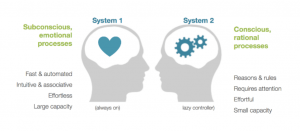
One of the findings from the preliminary research shows that a lack of information prevents customers from making a purchase. Because airline tickets are a ‘pay now, consume later’ product, there is not only a lot of uncertainty involved, but above all rational thinking (System 2). But just simplifying the information on a Web site will not automatically increase the conversion rate. For visitors to convert, System 1 must also be addressed. For example, by using texts that are easy to process and appeal to the visitor's emotions.
The preliminary study for Travix produced five main hypotheses:
The optimization program is characterized by the combination of thorough research into the ‘click stream’ (analytics) and psychological research into behavioral patterns. This reveals exactly which parts of a site should be tested to gain more insight into customer behavior. After calculating the test potential (test potential = at which places on the site can A/B tests be run where the chance of finding an effect is at least 80%) for all of Travix's domains, Travix's CRO team started running 1 test per week. After a month, this number was scaled up to 2 tests per week. To encourage the data- and evidence-driven testing culture in other branches of the company as well, support was provided for validating features developed by Travix's product teams.
To complement the testing capability, we started midway through our collaboration with Smart Notifications: a tool that uses Machine Learning to display conversion-enhancing notifications on Web sites. Users of Smart Notifications can write their own notifications or choose from industry-specific examples written by Online Dialogue's consumer psychologists. The specially developed bandit algorithm automatically selects the best converting message for a given customer at a specific time. To further capitalize on System-1 thinking, visitors were exposed to Travix's USPs during the buying process through these Smart Notifications. In this way, we tried to convince visitors that they were at the right place to buy their airline tickets.

If we look at the development of Travix's optimization program, we see that since the start of our cooperation, they have grown from a ‘MacGyver’: a lone warrior who can and does a little bit of everything, to an ‘A-Team’: a team of specialists in the field of CRO and A/B testing. The next goal of the collaboration is to develop an ‘Evidence Based Army. The data-driven and evidence-based testing culture of the CRO team should spread to all other product teams within Travix. In this way, all branches and disciplines in the company are constantly working to improve customer insights that in turn can lay the foundation for innovation.
By having good insight into the behavior of the visitors and thus being able to test more specifically, it was possible to quickly double the number of A/B tests and thus also increase the revenues of the project. The mutual support and knowledge sharing of Travix and Online Dialogue ensured that Travix's optimization team quickly grew in maturity in a short period of time. All goals of the initial collaboration have been achieved and we have laid a great foundation for the continuation of the collaboration where we will make the whole of Travix ready for a data-driven and evidence-based optimization culture.
 Nederlands Nederlands
 English