
November 24, 2025
Will AI make us smarter or dumber? The insights of Klöpping, Scherder and Online Dialogue
Reflection on Klöpping × Scherder by Simon Buil (Data Analyst at Online Dialogue)

In Dauphine Amsterdam, on October 1, 2019, the program featured the tenth edition of Digital Data Tips Tuesday (DDTT). In a room with about a hundred data analysts, conversion specialists, designers, freelancers and consultants, the ‘conversion canvas deep dive’ took center stage.
When Online Dialogue conducts a (behavioral) survey of its clients, the conversion canvas, also known as the 6V Conversion Canvas, takes center stage:

In this edition of the DDTT, there were three speakers who elaborated on the Versus, Voice and View components of the conversion canvas.
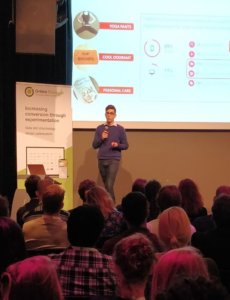
André Vieira, a Brazilian living in Germany and owner of Looptimize, was the first speaker and he elaborated on ‘Versus.
There has been competition since the beginning of time. We compete with each other because the resources we seek are limited. Online, this is no different. We strive for attention, clicks, conversions and revenue. These resources are also scarce and we will have to earn them. Every step in the customer journey is a “freaking battle field.” Competitive optimization is a way to get better at that.
André describes competitive optimization as, “Looking at customer journeys taking place on competitors’ properties to use the shit out of the cool stuff you find to your advantage.” In other words; Look at the customer journeys taking place on your competitors' websites and take advantage of them.
Competitive optimization takes a challenge in the customer journey and looks at how competitors address it. This results in hypotheses that need to be prioritized. It is important here that competitive optimization is not meant to be a stand-alone method, it is part of a CRO program.
Competitive optimization requires three things:
The most important source for finding your competitors is your customers. Ask them who your competitors are. This can be done through on-site polls, surveys, user research and chatbots, for example.
To find out the ‘what,’ competitive user research can be employed. There are two different forms of this:
Analyze highlights and striking differences. Highlights are facets that the competitor does better on. Striking differences are facets that the competitor does completely differently. Highlights and striking differences can be in:
For every insight you gain: Test this on your own website, because the competitor can also get it all wrong!
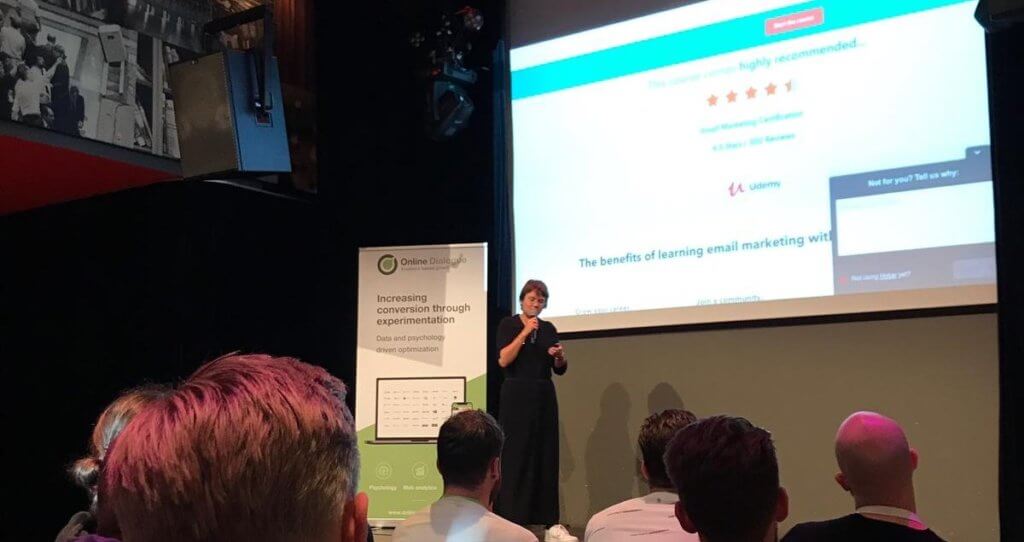
Then it was the turn of Els Aerts of AGConsult. She elaborated on ‘Voice.
“You can't just ask people what you want to know (Sorry).” With this quote from Erika Hall, Co-founder of Mule Design Studio and author, Els began her presentation. In fact, research questions are not the same as survey/interview questions. The research question, ‘How well does our website answer potential customers’ questions?‘ cannot literally be asked of anyone and should be broken down into smaller questions. For example, ’What is keeping you from completing your purchase today?’
The problem; Good surveys can be very valuable for user insights, however, most surveys are poor. To create a good survey, you need to think not in quantity, but in quality. Not in how many responses, but in the insights you get.
Els offers seven tips for surveys, interviews and user testing:
For website surveys, it is important to show them at the right time and place. When and where that is depends on the question. Think and use the least intrusive method. In addition, you can always put an in-page survey on the thank you page.
For interviews, it is important not to call them an interview. Invite people over for a chat. Prepare well for an interview, and keep it informal. In an interview, listening is the most important thing.
And finally, a tip for user testing. Don't answer the participant's questions. Instead, use the following techniques:
Conclusion of the lost art of asking questions: Always think carefully beforehand about what you are trying to find out.
albelli is an organization that sells personalized photo products online. In his presentation, Lukasz shows how they use data to make better decisions and how they got there.
To make more data-driven decisions, albelli has gone to a self-service model. Instead of doing, analysts now show how to do it by providing training and clear documentation. Also, analysts are closer to decision makers through the agile way of working. In addition, they are responsible for the entire optimization flow, instead of just the analysis part.
For each step in the funnel, albelli employs multiple KPIs, using Adobe Analytics, Launch by Adobe, LaunchDarkly and Adobe Target to collect data. This process started six years ago and now more than a hundred events are measured and more than eighty dimensions are in use.
Albelli uses this data for:
An example where data is used is in an e-mail campaign. First, account IDs are collected the moment someone logs on to the website. This data is then enriched with data from the CRM system. Next, target groups are created in Adobe Target, in which an A/B test is also set up. Finally, the A/B tests are analyzed for which, using R script, different databases are linked.
In closing, Lukasz gave six tips to apply yourself:List
This was the last DDTT of this year, but there will be DDTTs again next year as well. Would you like to attend these? Sign up for our newsletter and you'll stay up to date with all our events!
 Nederlands Nederlands
 English