
November 24, 2025
Will AI make us smarter or dumber? The insights of Klöpping, Scherder and Online Dialogue
Reflection on Klöpping × Scherder by Simon Buil (Data Analyst at Online Dialogue)

Before you start with behavior change and employing behavior change techniques (such as nudging and persuasion), it is crucial to understand behavior as well as possible. Only then will you be able to give your optimization process a clear direction. Eline van Baal wrote a step-by-step plan for this.
Psychology is a broad field of study. As such, the title "psychologist" is also comprehensive. But all psychologists have one thing in common: they analyze behavior. Psychologists try to find out what the behavior is and, in particular, why it is the behavior. Only when we know what the behavior is and why someone is exhibiting this behavior can we examine how to change it. But what is the best way to proceed? In this article, I share a step-by-step plan.
As a behavioral psychologist working in the digital field, I have a big advantage: behavior has never been more measurable. Just make sure the measurements on your website are accurate.
As a behavioral researcher, it is important to be able to see in as much detail as possible exactly what visitors are doing on your Web site. Set up measurements for all possible links, buttons, and so on. And make sure your measurements are accurate. That way you can find out what choices your visitors are making (and need to make) to reach their goals. And you'll learn at what points they get stuck.
Once you know what the behavior is, you can examine why it is the behavior. Compare multiple segments to be able to juxtapose decision-making processes in different contexts. The best advice I can give here is to hire an academic psychologist who is experienced in analyzing behavior.
You can also get started yourself and learn more about behavior analysis little by little. In that case, start from the realization that behavior is enormously complex, and that a multitude of variables influence behavior. That way you avoid making assumptions too quickly and falling into the trap of your own confirmation bias. Delve into decision-making processes and the influence of the environment to better understand the multiplicity of these variables.
Consider, for example:
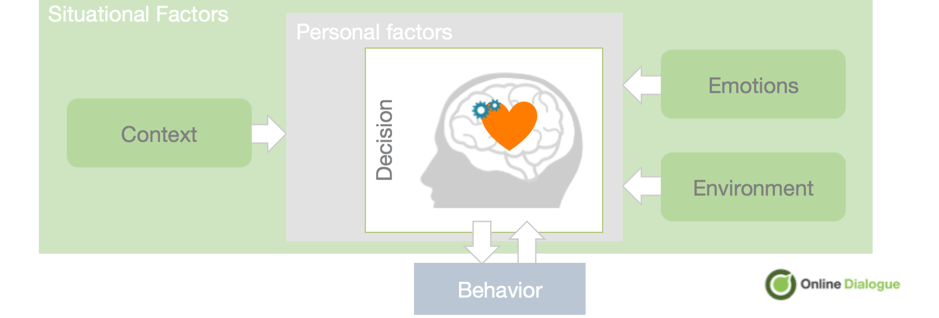
Although not all of these variables are easy to measure, they all affect your visitor's behavior. Therefore, always keep them in mind when analyzing your data and creating new hypotheses.
When you take a critical look at your behavioral data and compare segments, you can start formulating research questions. Look at the data to find out what is happening on your page. Where are visitors being stymied in reaching their goal? What decision do visitors need to make at that point? And how can you better guide them in making this choice?
Next, explore what you already know about your research question and formulate a hypothesis. In this way, you will arrive at a data-driven hypothesis about your visitor's behavior. When posing your research questions and hypotheses, make sure you keep a broad view and always look for alternative explanations for the behavior.
Because behavior is so complex and a multitude of variables affect it, it is critical to validate your behavioral analysis. The same goes for the possible explanations for the behavior. Because we study behavior, a usability survey or questionnaire will often not suffice. This is because you will then measure only a small aspect of human behavior: the spoken language. And as we all know, what we say can be quite different from what we do.
Prefer validating your (behavioral) findings through online experiments. In A/B testing, you adjust the visual design of your website based on your analysis. And so you're back to step 1: measuring behavior.
When the experiment is over you can begin to analyze the measured behavior. What did your modification (variant B) change about the behavior compared to the original (variant A)? Undoubtedly something very different from what you expected. Logical, because there are an awful lot of variables that are relevant.
Based on your findings, formulate new hypotheses that will help you further tease out and validate your previous behavioral analysis. Are there alternative hypotheses that could explain the measured behavior? Or could you perhaps test the same hypothesis again in a different design?
Putting the analysis of behavior at the center of your optimization process will give your A/B testing a clear direction. The structure and research attitude you gain with psychology allow you to actually learn about your visitor's behavior. Plus, you'll never run out of test hypotheses or ideas again!
By working from psychology to analyze and validate all possible explanations for your visitor's behavior, you'll be deluged with new questions, alternative explanations and thus new hypotheses for new A/B tests with every A/B test.
Hopefully the above roadmap will be of use to you. Any questions or additions? I'd love to read them in the comments!
Want to learn more about behavioral psychology? Then the Master of Online Persuasion course maybe something for you.
 Nederlands Nederlands
 English