

When you design a website or app, you want to entice people to perform a certain behavior: click the buy button, subscribe to your newsletter, read an article or open your app as often as possible (creating habitual behavior). But if our motivation is not very high, despite something being very easy to do, in most cases we won't do anything. So it is important that we stimulate our users‘ motivation. We do this according to Persuasive Technology expert B.J. Fogg through ’Sparking Triggers.
Facilitator, Signal and Spark
Fogg's behavioral model identifies three types of triggers; a ‘Facilitator,’ a ‘Signal’ and a ‘Spark. The so-called ’Sparking Triggers‘ boost our motivation causing us to take action. However, one must keep in mind that the type of trigger must be equal to the user's goal. With every step or choice your visitor is confronted with, you have to ask yourself whether the motivation needs to be increased or whether you just want to make something easier for your users. In this way, we can use a ’spark‘ at specific moments to stimulate the desired action. Fogg uses the following formula for this:
Behavior = the motivation to do something x the ease of doing it
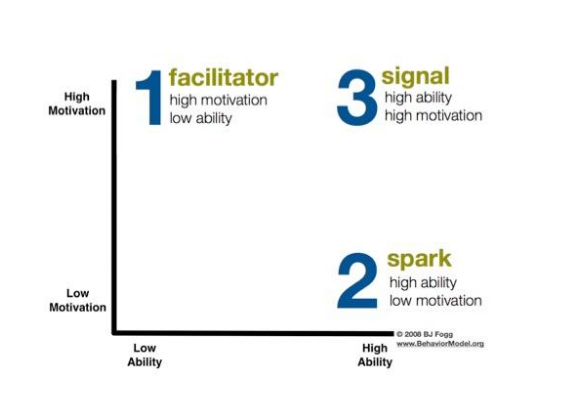
A Sparking Trigger as described by Fogg will prompt us to action when:
- we notice the Sparking Trigger;
- it appeals to one or more relevant motivations;
- the trigger occurs at the moment when we are both sufficiently motivated and in a position to perform the behavior.
An example for clarification
Fogg often uses the following example of a Sparking Trigger: If you haven't used your Facebook account in a while, Facebook automatically sends you the following email to entice you to log back in:
Hello,
You haven't been on your Facebook page recently.
You have received several notifications in the meantime.
1 message, 9 friendship requests
Greetings,
The Facebook Team
In this email, Facebook clearly focuses on increasing motivation to log in by naming the number of posts and friend requests, making this clearly a Sparking Trigger (focus on motivation and not convenience).
The Sparking Trigger as an A/B test
Paras Chopra, founder of Visual Website Optimizer (VWO), tested a Sparking Trigger by showing people a pop-up during their visit asking if they wanted to sign up for a free trial. The trigger increased motivation by using the word “free” and a clear call-to-action (Create an A/B Test). In addition, time also plays an important role in this A/B test. A user must have enough information for him or her to be interested in your offer. The moment you expose a user to your Sparking Trigger has a lot of influence on the impact the trigger has on the user. VWO's Sparking Trigger increased enrollment by 50%.
Left variant A & right the version with the pop-up Sparking Trigger (B):

Online Persuasion tips
If there are plenty of opportunities for your users to take action but motivation is way down, here are some tips to help you apply this Sparking Trigger technique yourself:
- Identify what motivating elements your customers lack to take action.
- Analyze what information can compensate for lowered motivation.
- Then analyze the best times to offer this information, selecting the most appropriate medium and/or device.
- Find the most appropriate medium and design your trigger to perfectly match the medium and the moment.
- Finally, broadcast your ‘spark’ at the chosen time, through the chosen medium, including the information that is going to boost motivation.
 Nederlands
 English