
November 24, 2025
Will AI make us smarter or dumber? The insights of Klöpping, Scherder and Online Dialogue
Reflection on Klöpping × Scherder by Simon Buil (Data Analyst at Online Dialogue)
Kom bij ons werken. We zoeken een Data-analist! Bekijk de vacature
Psychologists work everywhere and have a wide variety of job titles. Unfortunately, few of these job descriptions include the title Psychologist. So find your fellow psychologists. In order to meet colleagues and gain inspiration, Online Dialogue and the Netherlands Institute of Psychologists (NIP) a seminar for ‘hidden psychologists’.
The day was opened by Marco van Loon, Economic Psychologist by training and now User Experience Researcher at Rabobank. Rabobank does a lot of research on customer behavior, Marco explains. His work is a nice mix of economics and psychology and consists of lab and field work. The data side is fun, he states, but it's all about the customer experience and the feeling you leave with a customer. As a User Experience Researcher, Marco ensures that this feeling is properly conveyed to the customer. By removing all frictions and taking your customers' mental models into account, you can optimize your customers' experience as much as possible.

Gerben Langendijk is the only (licensed) Psychologist among his 18,000 colleagues at Booking.com. Booking.com is the world leader in the field of online bookings for (vacation) accommodations and is known for its data-driven way of working and the many experiments (1000+) they conduct daily to understand the behavior of their visitors. As a consumer psychologist, Gerben ensures that all these experiments are founded on psychological literature and clear hypotheses. If a test confirms one of the hypotheses, we continue to test on it, Gerben says. You keep experimenting to find out what works, with whom and why. The why question is for the psychologist.
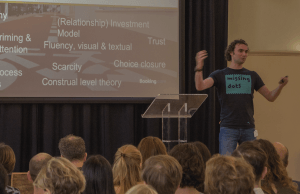
After the break, it was the turn of our colleague Eline van Baal. She too is convinced that the knowledge psychologists have can add a lot of value in business. According to her, the biggest stumbling block lies in the fact that people don't really know how and where to apply this knowledge. Eline talks about her role is as Optimization Psychologist at Online Dialogue: “The beauty of online is that you can measure behavior.” The large amounts of data available allow us to conduct more and larger experiments than is often possible in science.
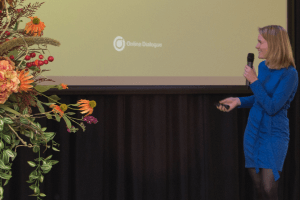
At one of our clients, the hostel booking site Hostelworld, we have now learned so much from our experiments that we have been able to create a behavioral model. And that model is now being used for all sorts of different purposes, such as product innovation and marketing. Finally, Eline also emphasizes the ethical side of her work. “Everything we do affects everything and everyone. By measuring the effect of the changes you make on the behavior of your website visitors, you keep control and prevent any negative effects.”
Recently, Mischa Coster started calling himself ‘Chief Psychology Officer. A job title that every organization should have, he claims. ’Because organizations where psychologists work simply do better“. Unfortunately, in practice it is not always easy to convince people of this. His tip: Believe in the added value of your field, seek out other psychologists in your organization and think as a scientist but act as a pragmatic consultant. Briefly, he explains all that a Chief Psychology Officer can do for you.

A Chief Psychology Officer has a scientific education (MSc or Phd), excellent counseling skills, experience in hands-on psychology, good coaching skills and is empathetic. He also lists a number of duties and responsibilities the Chief Psychology Officer can perform:
“The knowledge is there in many companies but we don't come out that we are psychologists. Show that you are psychologist. Call yourself a psychologist. If you are an HR employee, call yourself HR Psychologist from now on.”
The day ended with an enthusiastic presentation by Bart Schutz. As a psychologist, you are trained to be humble about your own knowledge. The influences of our context make behavior difficult to fathom. Yet many people think they know how human behavior works. Which results in unconsciously nonsensical work. For example, we know from psychology that rewards work better than punishments. But still, we see the government taking action only when someone exhibits undesirable behavior.

Bart calls on his peers to be more daring and proud of their profession. “Show yourself within your company and seek out other psychologists: your knowledge of behavior and statistics is your strength! But beware, because the incentive at companies is often not ethical. The fact that a fair amount of nonsensical things are done is not necessarily a problem. It does become a problem when something unknowingly unethical is done. If you are trying to change behavior, it is enormously important that you measure the effect. What are the consequences of your actions? Are there dangerous consequences? We as psychologists need to show the bigger picture.”.
Director of the NIP Linde Gonggrijp and Bart Schutz are happy that the room full of hidden psychologists are meeting each other now and they definitely want to follow up on that in the future. Together with Online Dialogue, the NIP likes to offer the hidden psychologists a platform to network and exchange experiences.
Are you excited and want to stay involved? Send a mail to eline.van.baal@onlinedialogue.nl.
 Nederlands Nederlands
 English