Last Thursday, Online Dialogue hosted yet another 28th Dialogue Thursday, which this time was all about psychology. What is the added value of psychology within the optimization process? How can we better understand our visitors? But above all: what does psychology teach us about our own role and attitude as the executives within the CRO process?
Gerben Langendijk: CRO & Psychology
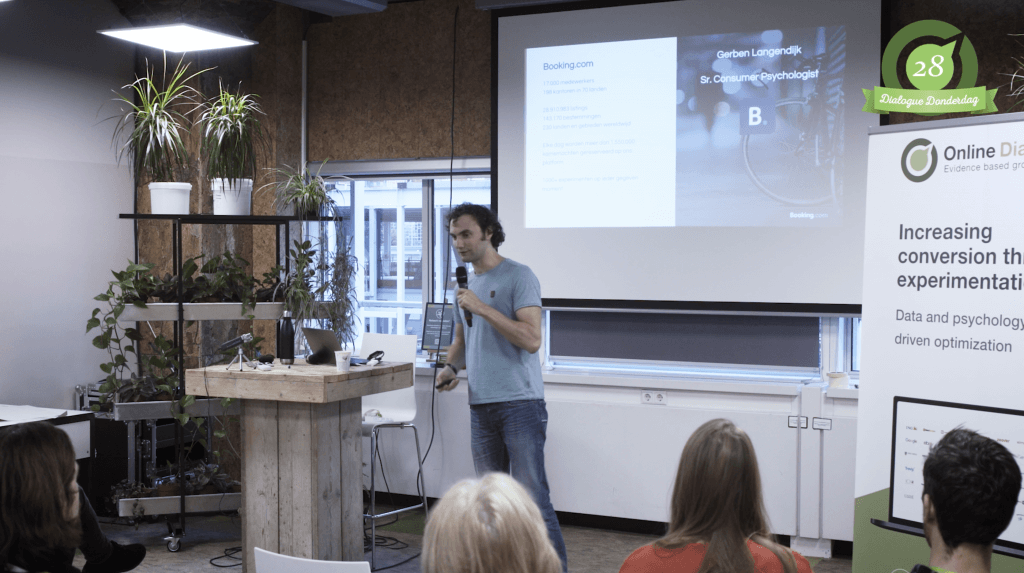
The afternoon started with a presentation by Gerben Langendijk - Senior Consumer psychologist at Booking.com. Of his 17000 colleagues, he is the only one who fills the position of consumer psychologist within the organization. And then with no less than 1000+ experiments live at any given time.

What does a consumer psychologist do at Booking?
When he was just starting out at Booking.com, Gerben mainly got questions about so-called psychological tricks (think techniques such as social proof and choice overload). But reading about and applying these psychological techniques is something anyone can do themselves. That's not where the value of a consumer psychologist is for your CRO program.
The role of psychologist at Booking.com has three components:
- Finding out when such an adjustment works, when it doesn't, and why or why not.
- Putting the effect of adaptation into a bigger picture. Has there been more experimentation with this effect? What were previous outcomes? What else might this effect be related to? Are there alternative explanations?
- Making sure his colleagues base their assumptions on different sources. Anyone within Booking.com can come up with a new idea for an experiment. The more one bases these ideas on existing sources, the more direction you get in your CRO program.
Trick or program?
During his presentation, Gerben cites Kurt Lewin's formula: B=f(P, E). Behavior is a function of personality and environment. Thus, there are always more factors at play. Which factors these are and how they relate to each other is difficult to figure out, but a good place to start are the pre-existing models of behavior derived from scientific research.
For example, you can use the behavioral model of Choice overload as a basis for your hypotheses. By examining the various factors step by step, experiment by experiment, you gather an incredible amount of valuable information about your visitors. In this way, you can gradually build on the model and adjust old insights. For whom does the adjustment work? For whom doesn't it work? And what factors influence the effect of the adaptation?

When you get started in this way, applying psychological tricks is not bad at all, according to Gerben. The important thing is that you will learn something from it.
After the break, it was also the turn of our colleagues Joost Baalbergen, Roos van Dam and Eline van Baal to share their knowledge and experiences. One by one they answered questions such as: What is the added value of a psychologist within the CRO process? What role do you assume when researching behavior? And how do you proceed?
Joost Baalbergen: Shooting chickens out of the sky
For anthropological research, a tribe from New Guinea, who had never been in contact with other people before, was exposed to TV clips of downtown New York. When asked what they had seen, their only answer was “chickens.” Everything they saw was foreign to them and so they could not describe it. Except the chickens.

What is the added value of a psychologist within the CRO process?
What this study and many others have proven is that our cognitions determine how we see the world. There is what is called a totality illusion. We explain reality in the terms we know.
This also means that the words we know determine the reasons we can give to explain the behavior of others. And that is exactly one of the reasons why it is good to hook a psychologist within your CRO program. Despite the fact that even a psychologist cannot experience and describe a complete picture of reality, the knowledge they have about behavior provides broader frameworks.
Therefore, according to Joost, it is enormously important that we not blind ourselves to what we think behavior looks like and is determined. We need to confirm our assumptions. But how? What are the ways to confirm or reject your assumptions and how reliable are they? The “Hierarchy of Evidence” of Ronny Kohavi makes a good distinction here.

Roos van Dam: Confirmation Bias
The Confirmation Bias: the tendency to look for information that matches our expectations and beliefs. People make decisions based on the information we have available. Unconsciously, we ignore new information or twist the information to fit our point of view.

Help Rose with her research!
To prove the presence and effect of this bias, Roos conducted a small survey among all visitors of the Dialogue Thursday. Prior to the Dialogue Thursday, all guests received a questionnaire containing 3 experiments and with each experiment 2 questions: Which variant won in this A/B test? And why do you think this variant won?
What they did not know, however, is that one half of the participants had a slightly longer intro in which a number of behavioral insights were shared. And what turned out: the participants who had indeed read these insights adopted the words and statements from the intro when asked why they thought the chosen variant would perform best.
What role do you assume when researching behavior?
Therefore, when researching behavior, it is enormously important to be aware not only of the biases of the site visitor, but also of your own biases. Although we can never avoid confirmation bias altogether, Roos shared some tips to reduce the presence of the bias as much as possible.
- Be critical: question everything and use a variety of sources.
- Explore alternative explanations.
- Establish your hypothesis in advance!
Eline van Baal: How do you proceed?
Psychologists try to find out what the behavior is and, in particular, why it is the behavior. Only when we know what the behavior is and why someone is exhibiting this behavior can we explore how to change it. But what is the best way to proceed?
1. Measure behavior on your website
As a behavioral psychologist working in the digital field, Eline has a big advantage: behavior has never been more measurable. However, make sure the measurements on your website are accurate.
2. Analyze as many explanations for the behavior as possible
When you take a critical look at your behavioral data and compare different segments, you can start formulating research questions. Look at the data to find out what is happening on your page. Where are visitors being stymied in reaching their goal? What decision do visitors need to make at that point? And how can you better guide them in making this choice?
Next, review what you already know about your research question and formulate a hypothesis. which behavioral determinants are important and where are they important? To find out as much as possible about your visitor in this phase, we use the 5V model:

3. Explore possible explanations for the behavior
Because behavior is so complex and a multitude of variables affect it, it is critical to validate your behavioral analysis. The information you have gathered and the hypotheses derived from it are just pencil sketches to guide your experiments. Also, always do multiple experiments to test your hypothesis.
4. The analysis
When the experiment is over you can begin to analyze the measured behavior. What did your modification (variant B) change about the behavior compared to the original (variant A)?
Based on your findings, formulate new hypotheses that will help you further tease out and validate your previous behavioral analysis. Are there alternative hypotheses that could explain the measured behavior? Or could you perhaps test the same hypothesis again in a different design?
The common thread of your CRO program
Putting the analysis of behavior at the center of your optimization process will give your A/B testing a clear direction. The structure and research attitude you gain with psychology allow you to actually learn about your visitor's behavior. In addition, you will never again run out of test hypotheses or ideas.
Create a common thread in your research and discover what the real effect of your experiments is!
Want to learn more about the 28th Dialogue Thursday? Watch the compilation video for an overview of the afternoon or sign up for our
newsletter To keep up to date with all our events!




 Nederlands
 English