March 5, 2026
Why experimentation is becoming an operating model for smart organizations
A conversation with Valentin Radu, founder of Omniconvert, on experimentation as an operating model, AI and sustainable digital growth. Read more
We are looking for a data analyst! Check the job posting.
Last week I was in Copenhagen for the second time for the ConversionBoost congress. This year was extra special for me: I got to be the give opening keynote. And that in a city that feels like my second home. Since I studied there in 2009, I return every year to visit friends and see the beautiful city. And so this year with a room full of peers, inspiration and energy.
In addition to my own presentation, I thoroughly enjoyed the talks by Lucia van den Brink, Craig Sullivan, Erin Weigel and Juliana Jackson. Below are my summaries of their keynotes and the key lessons I took away from them.
Many specialists succeed very well in optimizing websites for their users. Through extensive research and A/B testing Web sites are tailored to visitors' needs as much as possible. But when it comes to internal processes like collaboration and stakeholder buy-in, that same mindset is suddenly forgotten. We send A/B test results, present about updates but never ask ourselves if this fits the needs of our colleagues.
In my presentation, I showed that when we also use our experimentation mindset internally, we feel more connection and support from our colleagues and stakeholders.
I shared frameworks to build support, build internal support and get colleagues on board with the experiment story. Consider:
➡️ “Experiment within your organization, just as you do with your digital products.”
Lucia kicked off her talk with a simple but powerful idea: the more diverse your team, the better your ideas and results. And they called that the Experimentation Bonus.
She showed that when you involve people from different disciplines - from marketing to customer service, from developers to legal - in generating test ideas, you not only get more ideas, you get more original and valuable ideas.
She illustrated this with concrete examples from her work:
Lucia also provided important prerequisites: psychological safety is crucial, as is space to be yourself. She shared practical tips, such as using the “1-2-4-all” brainstorming method to gather ideas, and documenting all ideas in tools such as Airtable.
➡️ “If you want to keep improving, you need ideas from outside your bubble.”
Erin presented her model for Conversion Design, which is discussed at length in her book Design for Impact. She showed how real impact occurs at the intersection of design thinking, scientific validation and business value.
Design, she says, is not just aesthetics, but the ‘translation of intention. And conversion? That's about transformation. Not just sales, but especially meaningful change.
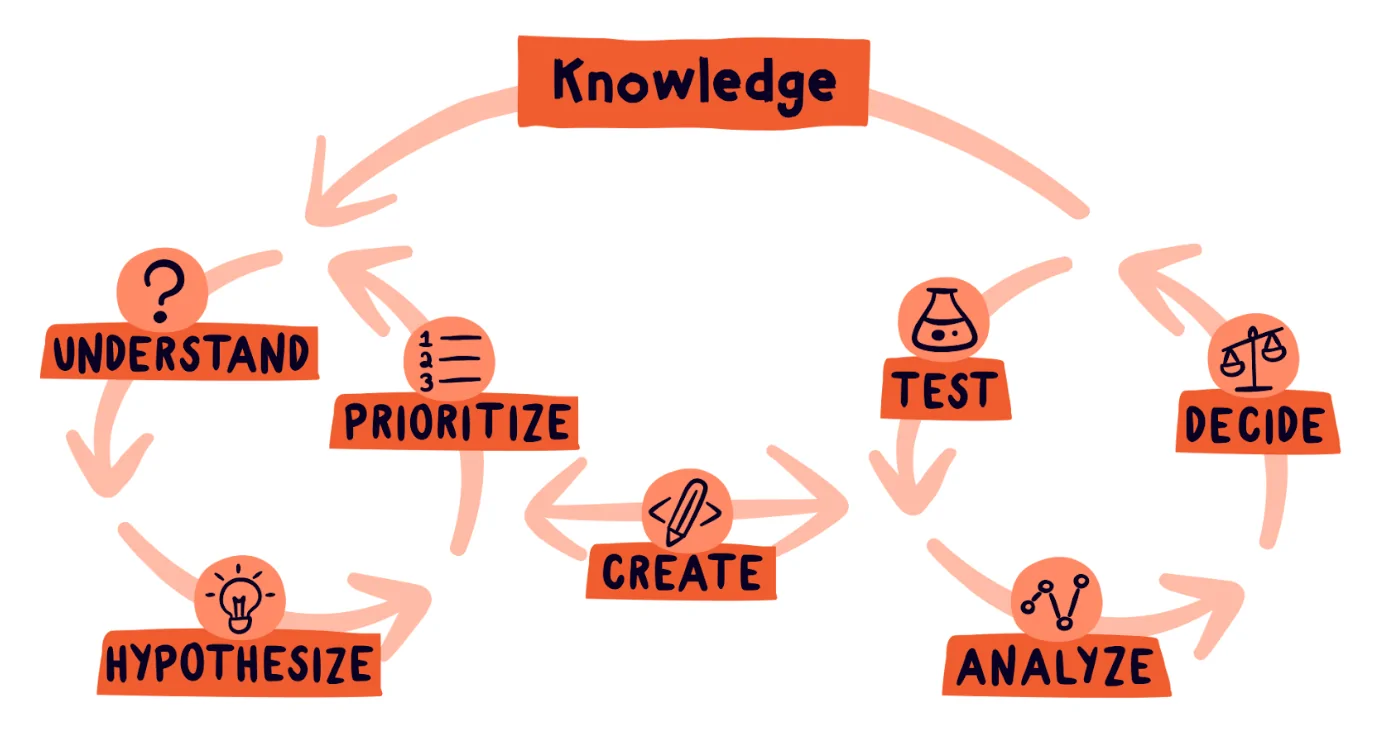
From there, she presented her dynamic model with seven steps for conversion design
Source : https://erindoesthings.com/design-for-impact/
Conversion Design contributes to growth by focusing research on customer problems that make a real impact on your business goals. The testing phase is all about gathering evidence, with well-designed A/B testing being the gold standard. This shifts an organization from opinions to real insights.
Repeating this process and making small, good decisions all the time creates a compounding effect that leads to serious growth in the long run.
➡️ “Conversion design combines three distinct concepts; design through human-centered problem solving, science through good experimental design and where it intersects, with business through value creation and transfer. And this is where the magic happens: in the middle.”
Juliana closed the day with a strong presentation. Her message was clear: the way many organizations look at data and CRO is too limited, too superficial and too internally focused.
She began with a striking statement: “I am the anti-christ of CRO.” What she meant by that? That she no longer thinks the conventional way of optimizing, such as funnel analyses, heuristic analyses and A/B tests on buttons, is sufficient. Because the world in which our customers move is much broader and more diffuse than just our own website.
According to Juliana, the customer journey is not linear, and certainly not limited to your own channels. People form their opinions about your brand in places where you have no control: Reddit, review platforms, social media, YouTube comments. This is where emotion, trust or doubt arise.
If we optimize only what is within the funnel happens (think: checkouts and CTAs) then we miss the context that brings people to that funnel in the first place or keeps them away from it.
She called for a brand to take responsibility for that entire journey, even beyond your own channels, and invest seriously in perception and trust.
The solution? Content market fit. Research what people are looking for, what they want to know, and make sure your content matches that - at every level of the journey.
➡️ “If you combine experience with perception and you add this to the existing data, you can create better experiences than with any heuristic evaluation.”
Conversionboost 2025 was for me a special conference full of energy, fun people and depth in a beautiful location.
Thanks to all the speakers for their insights, to Ole Gregersen, the organizer of this great event, and to Copenhagen for the familiar conviviality. See you all next year!

 Nederlands Nederlands
 English