

We are looking for a data analyst! Check the job posting.

Dialogue Thursday #50: from CRO to customer journey optimization

On Thursday, March 12, we celebrated a special milestone: the 50th edition of Dialogue Thursday. What once began as a small-scale initiative to bring peers together around conversion and experimentation has grown into a regular meeting place for professionals working on digital growth, customer experience and organizational development.

During this anniversary edition we not only looked back on fifty editions full of insights, cases and encounters, but above all we looked ahead. Because one thing became more than clear: the field is changing. Whereas for years CRO focused on improving a page or increasing a conversion rate, the focus is increasingly shifting to optimizing the entire customer journey.

50 x DiDo

Dialogue Thursday is Online Dialogue's knowledge event, where professionals from the profession come together to share knowledge, practical experiences and new developments in the field of experimentation, customer behavior, UX and data. Each edition focuses on a topical theme, with room for honest stories, concrete examples and conversations that go beyond the standard success stories and best practices.

This celebration edition took a different form than usual. We celebrated DiDo #50 with a panel discussion, led by Ronald ter Voert, with Alex Bloemendal (123inkt.nl), Florentine Huijsmans (Praxis / Maxeda) and Xeï Hulshoff (My Jewellery). 

Together they reflected on the evolution of the CRO profession, today's challenges and the future of experimentation.

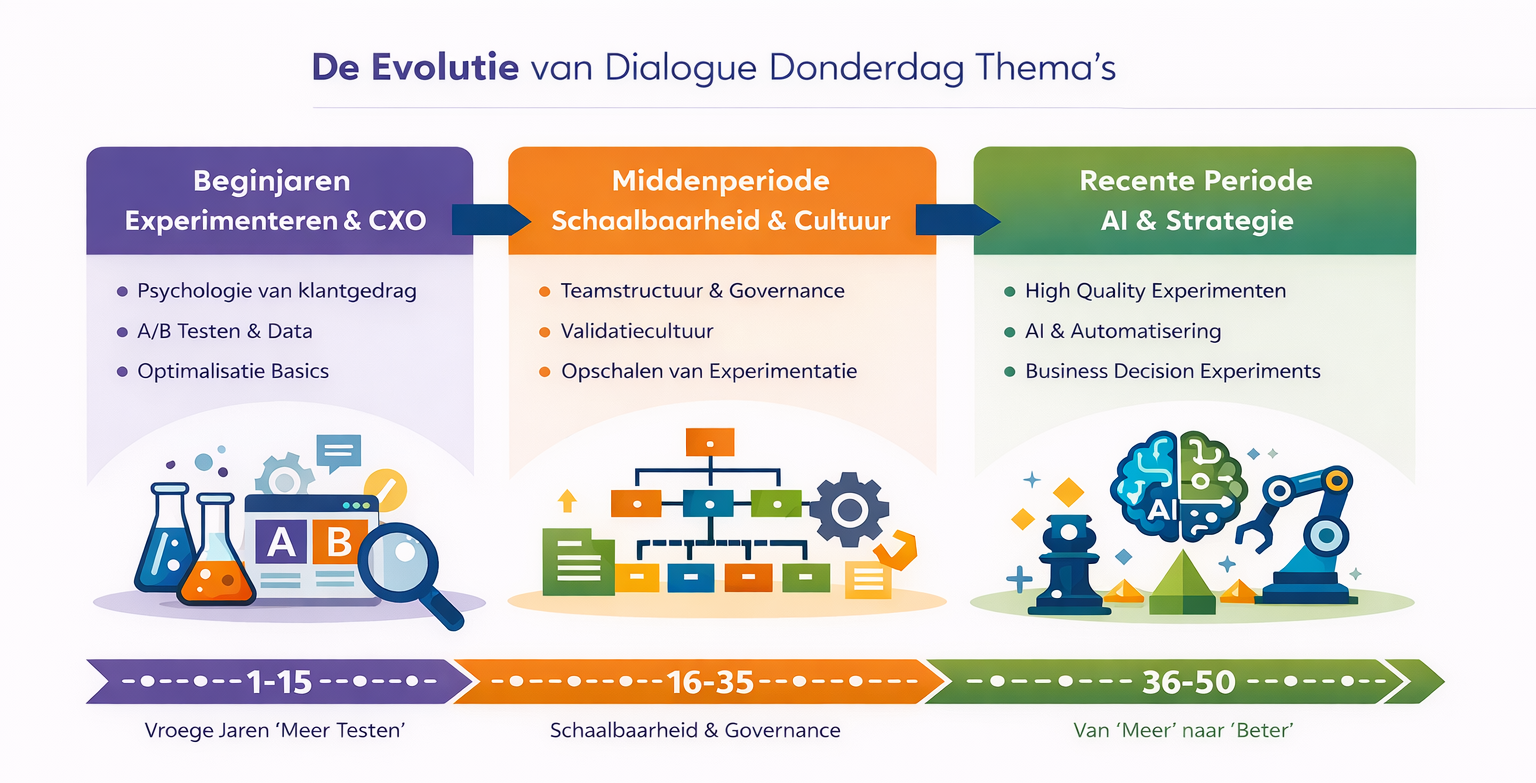
The evolution of 50 dido topics - 2009 to now. Source ChatGPT, Online Dialogue

From buttons to strategic testing

The field has professionalized greatly in recent years. We are long past the days when optimization was mostly about testing the color of a button or adjusting a headline. Of course, experiments are still important, but the context has become much broader.

Increasingly, it is no longer just about Conversion Rate Optimization, but Experience Optimization: improving the overall customer experience across the entire journey. In Silicon Valley, this is sometimes called growth engineering. That development requires a different way of working. Not one specialist who “does the tests”, but a multidisciplinary collaboration of designers, data analysts, researchers, developers and behavioral experts to come to better choices for customer and organization.

Experimentation is a strategic tool

An important theme during the afternoon was the position of optimization in organizations. Too often the profession is underestimated and placed somewhere in a marketing department, without direct influence on direction or decision-making. While that is exactly where a lot of value is lost.

After all, optimization is not a collection of separate A/B tests. It is a way to reduce uncertainty, inform choices and learn smarter as an organization. Therefore, the greatest benefit of an experiment is by no means always in the uplift alone. Often the real value is in the insights a test delivers: learnings that show how customers think, where processes falter and which assumptions within teams turn out to be wrong.

This is precisely why optimization deserves a clear place at the table. Not as an executive discipline, but as a strategic steering tool, a core competence which should be central to every organization.

More data does not automatically mean better decisions

At the same time, the maturing of the profession also brings new challenges. Data is more accessible than ever. Dashboards are open, insights are readily available, and many managers now look at it themselves. In itself, this is positive, but it also creates a familiar area of tension: people draw their own conclusions based on isolated figures, without context or clear hypothesis.

During DiDo #50, this recognizable phenomenon recurred several times. When anyone can dive into data at any time, it becomes more difficult to maintain focus and carefully interpret what you actually see. Especially in organizations where priorities shift regularly and boards change direction quickly.

The lesson that emerged: the quality of optimization does not start after the fact, when explaining results, but at the front end. With sharp hypotheses, clear research questions and clear choices about what you actually want to learn. Only then do you build trust in data instead of discussion afterwards.

Customer behavior wins over business logic

Perhaps the most recurring insight of the afternoon: what feels logical to the organization does not necessarily make sense to the customer.

Using several real-life examples, it became clear how dangerous it is to rely on internal assumptions, best practices or “common sense.”.


My Jewellery also found that customer behavior does not always follow prevailing UX rules. Whereas it is often said that call-to-actions should be as high as possible on the page, it worked well there to place large images more prominently. That created more tranquility, more experience and ultimately a conversion increase of 11.5%.

Another example showed how insidious internal logic can be. A page was cleaned up because certain bestseller blocks were “duplicate” and thus seemed redundant. From the company's point of view, a logical choice. But customers actually turned out to like that repetition. The result: a 7.8% drop in conversion.

The common thread is clear: context is everything. There are no universal best practices that are guaranteed to work. Only research, testing and looking closely at real behavior of your customers will take you forward.

Of course, AI also came along

In addition to the development of the profession itself, there was a focus on what AI is going to mean for the future of optimization. The expectation that recurred several times was that the traditional Web site will change significantly in the coming years.

Interfaces are becoming increasingly chat-driven. Consumers will not want to search, compare and evaluate everything themselves, but will outsource some of this to AI agents who prepare or even make choices on their behalf. This also changes the playing field for brands and e-commerce parties.

The question then becomes not only how your website converts, but also: how do you ensure that your brand and offerings are visible, relevant and compelling to a language model or agent? In other words, how do you become LLM-proof as an organization?

At the same time, AI is also changing the work of optimization teams themselves. Already, AI is being used to analyze data sets faster, generate hypotheses, write code and accelerate experiment ideas. That doesn't make the profession any less human, but it does make it faster and potentially even more strategic. Precisely because execution is getting smarter, the importance of direction, interpretation and human insight is growing.

Distinctiveness shifts to after purchase

One of the most interesting thoughts was about where brands can truly differentiate themselves in the future. If AI takes over more and more functional choices at the front end of the customer journey - which product is best, where is it cheapest, what best fits my query - then differentiation on product information alone will become increasingly difficult.

That means optimization will have to focus even more explicitly on what happens next. On brand experience, trust, packaging, service, tone, convenience, loyalty and the feeling a brand evokes.

It is precisely the post-purchase phase that thus becomes more important. Because when functional comparison becomes automated, emotion and experience remain as distinguishing factors. Brands that succeed in creating a strong, recognizable and consistent experience are building an advantage that is less easy to copy.

50 editions later, the core is still the same

Although the field has changed tremendously, something else remained true during this anniversary edition: the core of optimization is still curiosity. Dare to investigate, dare to question assumptions and look at what customers actually do rather than what organizations think they do.

The tools change, the scope expands and AI adds a new layer, yet the essence remains the same: helping organizations make better choices based on behavior, data and experimentation.

And therein lies the value of an afternoon like Dialogue Thursday. Not just in the knowledge being shared, but in the collective conversation about where the profession came from, where it is now and where it is moving.

On to the next fifty! 

You may also find these blogs interesting

There are currently no blogs on this page.