

We are looking for new colleagues! Check out our vacancies.

How to optimize a proposition with data, UX and user research

Many marketing campaigns fail not on reach but whether or not the message (or proposition) is understood. 

It often goes like this: the message is in place, the product is well thought out, live with that campaign. And then: nothing. Visitors on your beautiful landing page but without desired results. In many cases this is not due to targeting, creation or budget but due to something more fundamental: the proposition is not well understood by the target group. Time to optimize your proposition through user research. 
From assumptions to behavior

For a large energy supplier, we analyzed a campaign around a new type of energy contract. The campaign was already running and generating traffic, but the results were lagging. Due to limited time beforehand, the campaign had gone live without extensive user research, so it only became visible during the campaign where users got stuck and the proposition did not land well.

What do we actually want visitors to understand?

  • Do people understand what is being offered here?
  • Do they recognize the value?
  • And what stops them from choosing?

From those questions, we created a combination of:

  • Quantitative analysis (on-page behavior)
  • Qualitative research (how people think and experience).

That combination is always the basis of how we work. Data shows what is happening. Behavior shows why. And in that very difference is often the key to improvement. What data shows you (but doesn't yet explain) The first insights came from behavioral data.

We saw, among other things:

  • A relatively high exit rate on the campaign page
  • That a large proportion of users barely scrolled beyond the first screen
  • That the most commonly used action was focused on calculating costs
  • That math examples received a lot of attention, despite their position further down the page
  • And that only a small fraction of visitors used the FAQ.

Especially noticeable was the limited scrolling behavior. Many users lingered above the fold and barely looked at the rest of the page. This suggested that the information that was immediately visible did not motivate enough to explore further how the product worked or what the benefits were.

At the same time, we also saw a relatively high exit rate on the page. Based on data alone, it is difficult to determine exactly why users leave, but they are signals that the page did not provide enough direction, clarity or persuasion.

Such insights help recognize patterns, but also raise new questions:

  • Why do people primarily look for cost?
  • Why don't many users scroll further?
  • Why is the FAQ section used relatively infrequently?
  • And what information are users missing to move forward?

Understanding that requires the next step.

How qualitative research makes a difference

To understand the ‘why’ layer, we employed targeted qualitative research. Depending on the question, we choose the right method in this. In this case, we used user testing, where participants went through the page and flow.

This kind of research makes visible:

  • What someone thinks when seeing a page
  • where confusion arises
  • and what information a person needs to proceed.

Precisely because you hear and see people, you get insights that are not reflected in data alone.

What feels logical for the organization may not necessarily work for the target audience. Qualitative research makes that difference visible.

What we learned from users

The combination of data and research made several things clear.

  1. The proposition was not recognized

Users confused the new form of contract with a standard or permanent contract.

This had several causes:

  • The name of the new form of contract gave little direction
  • The value was not immediately apparent
  • The link to the campaign message was missing.

The proposition was there, but didn't come across.

This is crucial because our brain categorizes new information at lightning speed based on existing mental models. If something directly resembles a familiar category - in this case, a standard energy contract - the distinctiveness of your offering disappears.

A good proposition is not recognized in a presentation, but in behavior.

User research through Lyssna

  1. Users primarily sought security

Instead of wanting to fully understand the product, users were mostly concerned with their own situation.

They wondered:

  • What happens to my current contract?
  • Will I keep my discount?
  • Does this contract fit my situation?

These kinds of questions don't always show up in standard metrics; they show up directly in conversations and observations. 

This shows that uncertainty often plays a bigger role than interest. People may well be interested in a new offer, but until it is clear whether it suits their situation, they prefer to postpone a decision. Doubt delays choices.

  1. Complexity caused dropout

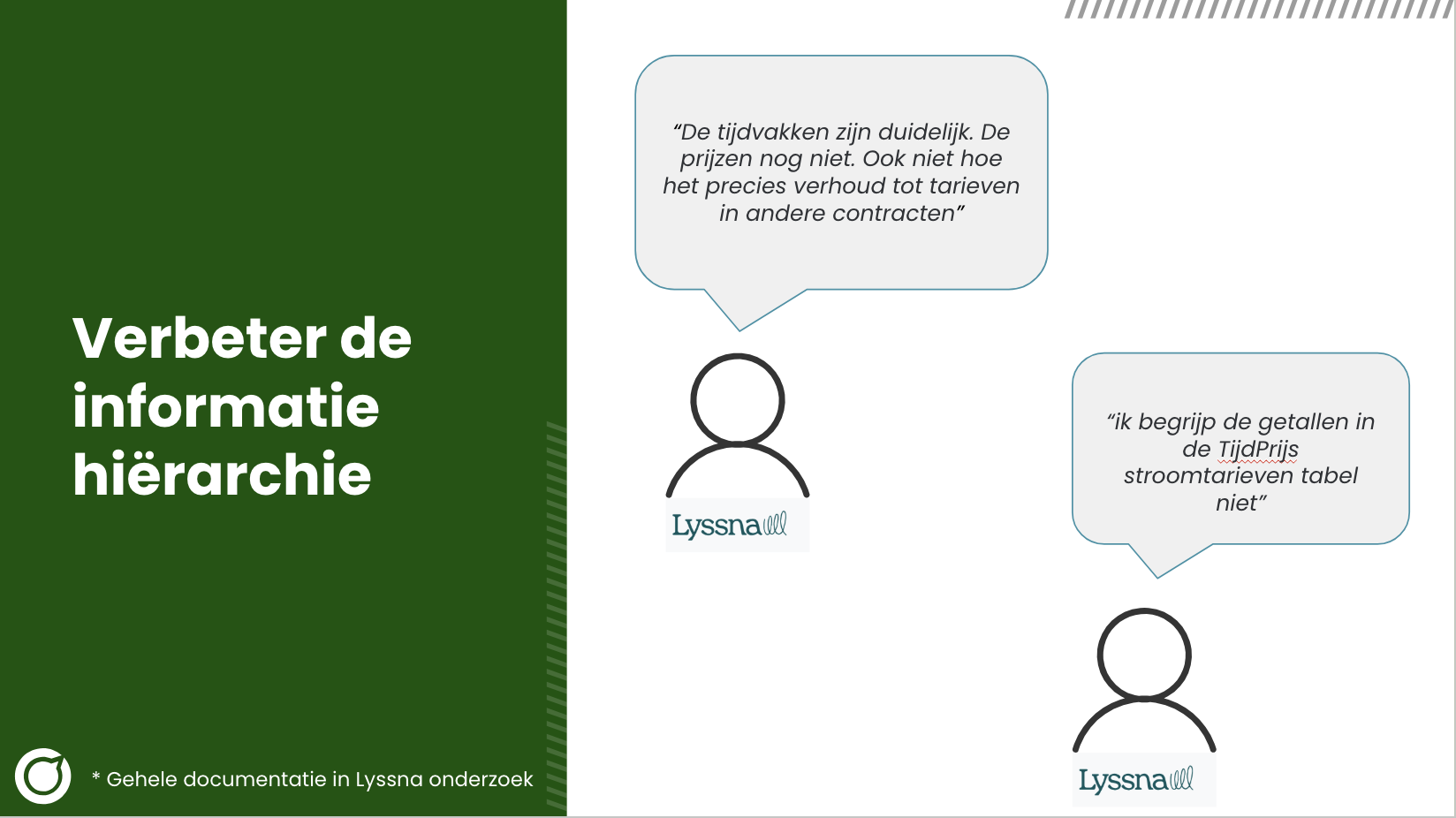
The page contained complex jargon information and that actually worked against it.

During user testing, we saw that people:

  • had difficulty scanning information quickly
  • Stuck in tables and calculations
  • and felt they had to “figure it out first.”.

That makes sense. The more mental effort something requires, the more likely people are to drop out. Our brain naturally seeks ease and quick interpretation, especially in an online context where alternatives are one click away.

So the lesson here is simple: the more effort something takes to understand, the less appealing it feels. Even if the content is strong.

  1. Lack of context in the purchase flow

In the purchase flow, a large proportion of users got stuck choosing a contract.

By watching along with users, it became clear why:

  • they expected multiple options
  • but only got to see one
  • leaving them unable to determine if this was a good choice.

This is another recognizable psychological mechanism. People rarely judge choices in isolation. Without a reference point, it is difficult to assess value or feel confidence in a decision.

Without comparison, doubt arises and thus procrastination.

From insight to action

We translated our insights from quantitative and qualitative research into a recommendation with concrete improvements.

In this case, that meant, among other things:

  • Sharper wording of the proposition at the top of the page
  • Improving information hierarchy
  • Simplify complex content
  • Working more with visual elements rather than textual elements
  • Adding comparison options
  • And guiding users instead of getting them stuck.

By testing hypotheses and extracting insights quickly, these types of adjustments could be made as early as during an ongoing campaign.

Why this approach works

Qualitative research is often seen as a pre-validation method of a project. But it is especially valuable during an ongoing campaign. You don't have to wait for large amounts of data or significant test results. With relatively small research groups, you can already pick up sharp insights about behavior and motivation.

This helps to:

  • Make the right choices faster
  • avoid unnecessary investments
  • and more targeted optimization.

In conclusion

Many organizations optimize campaigns based on numbers. But numbers only show what is happening. Only when you understand why people do what they do can you really improve and adjust. And often the biggest gain is not in the campaign itself, but in how well the underlying proposition is understood.

Wondering how this plays out for you?

Are you running into campaigns that generate traffic but yield little?

Or do you doubt whether your proposition is clear enough for your target audience? We are happy to look with you, from initial analysis to concrete improvements. So that you don't optimize on assumptions, but on what people actually do.

You may also find these blogs interesting

There are currently no blogs on this page.