March 5, 2026
Why experimentation is becoming an operating model for smart organizations
A conversation with Valentin Radu, founder of Omniconvert, on experimentation as an operating model, AI and sustainable digital growth. Read more
We are looking for a data analyst! Check the job posting.
In early October, Ton Wesseling was on stage at Conversion Jam. An annual event, organized by Conversionista, which takes place in both Stockholm and Oslo. Besides Ton, among others, Steven Van Belleghem, Morgan Brown, Els Aerts and Tobias Ahlin spoke. Herewith three lessons on how to achieve growth now, how this will go in the future and what impact this will have on CRO.
Morgan Brown (growth product manager at Facebook) explains in his presentation how to achieve growth today. At Facebook, all product teams employ the Understand, Identify, Execute loop.
In short, each team within Facebook must understand the business, identify growth opportunities and act on them perfectly. Within this method, everything revolves around realizing small gains. If you improve one percent every day, you achieve growth upon growth. This is what Morgan calls ‘supercharging growth.
In the Understand phase, each team must understand the goal. The North Star Metric (NSM) is indispensable here. The NSM is a specific metric for the core value of a product or service. Here it is essential that it measures the added value to the customer, rather than the monetary value to the company. For example, the NSM at AirBnB is the number of nights booked, at Facebook seven friends in the first ten days, and at Slack two thousand messages sent per team. All of these NSMs measure created value for the customer.
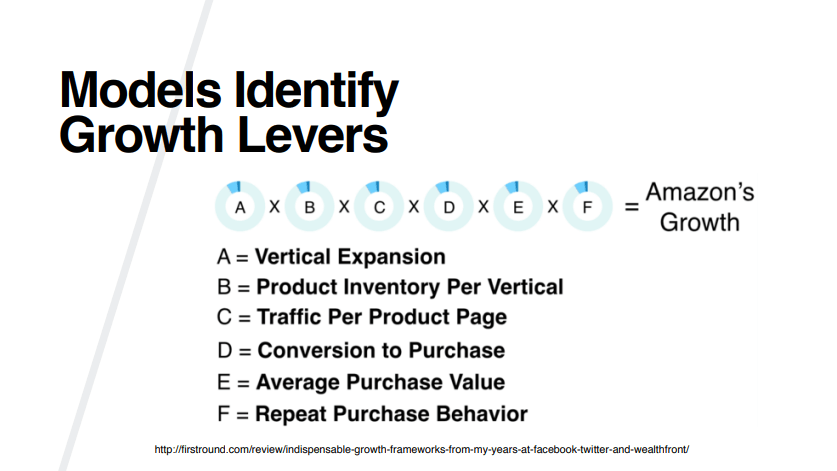
Then, to set up experiments that meet the NSM, you need to build a growth model. A growth model is a simple representation of the business that identifies growth levers (see Amazon example below). Once you know the organization's growth levers, then you know where you need to focus to achieve growth.
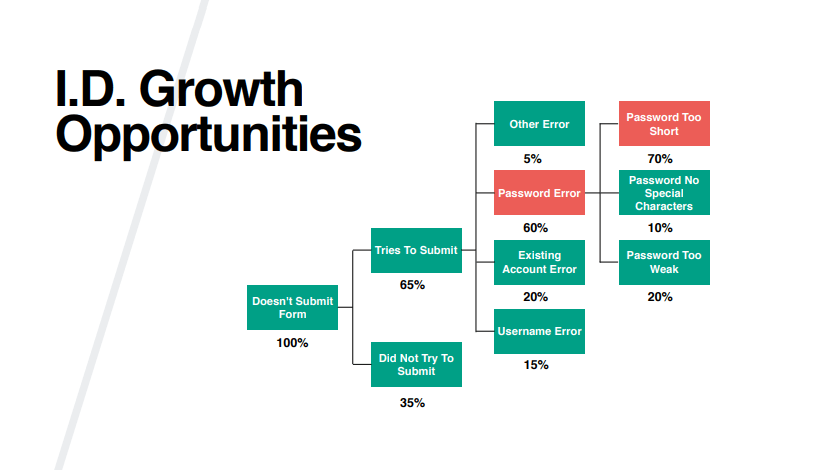
The purpose of the Identify phase is to find out where the best opportunities lie to achieve the goal. To do this, you need to dive into the data. Research where people are getting stuck and keep digging until you know exactly where that is and for what reason. To get to the best result in the Identify phase, your data must be completely in order.
Implement the plan through ‘high tempo testing. Test as much as possible. It's better to make a lot of decisions with a slightly higher error rate than to make fewer decisions with a lower percentage of errors. As long as it's not a life or death situation (and it often isn't), there's a lot of opportunity to move faster and thus grow faster. Prioritize all the ideas you have and test as much and as fast as you can.
By executing Understand, Identify and Execute well, you ensure that you continuously make small gains and thus grow rapidly. Don't look for a magic growth hack, but make sure you get a little better every day. These small gains add up to ‘supercharging growth.
According to Ton (founding partner of Online Dialogue), in the near future our CRO jobs will disappear and this, according to him, is not a bad thing at all.
The field of CRO began ten years ago when tools like VWO and Optimizely entered the market. At Online Dialogue Ton started testing mainly ‘low hanging fruit’, often with unreliable data. Nevertheless, companies became convinced and Online Dialogue was able to set up CRO teams. And with those teams as many experiments as possible were performed.
In addition to the CRO teams, you have product and marketing teams. They often work, through short sprints or on a campaign basis, at a completely different pace than the CRO team. However, the CRO team demands that no changes are made on the pages where experiments are live. CRO teams block pages and thus disrupt the pace of the product and marketing teams.
We, as CRO specialists, will have to be humble in our craft in order to actually get other teams on board. Blocking pages is not part of that. As long as a CRO team remains separate from the rest, it will not be sustainable in the long run. The different teams will not get into the same working rhythm and, moreover, this way CRO will never become a team effort in which everyone participates. Ton explains: “ We are currently running at the wrong pace, with the wrong mindset to grow.”
Ton contributes several reasons why it is a good idea to end our CRO jobs.
Starting because of the name. Conversion Rate Optimization is way too small. ‘Evidence Based Growth’ would be more appropriate. According to Ton, we need to start optimizing organizations and not just focus on low-hanging fruit. It is too costly to have CRO teams working on small experiments that AI can also perform.
In addition, it is important to look beyond just the website. We need to optimize the customer journey, this can even be right into the store. And for that we need good KPIs. It should not be about clicks, but about the lifetime value of customers. According to Ton, we need an Overall Evaluation Criterion (OEC) that serves as a guideline for all departments within an organization.
In other words, we have the wrong name, perform the wrong work, don't work on every channel and do it with the wrong KPI and methodology.
Optimization is all about effectiveness. Making sure resources are working on things that make an impact. For efficiency, there are already lots of popular methods such as six sigma, scrum and agile. Efficiency ensures that you create more with the same number of resources.
CRO must combine both. Create better things with the same number of resources. In other words, maximize the number of positive impacts with the same number of resources.
The CRO team is only a small part in making impact. To maximize the number of positive impacts, each product and marketing team should validate itself. In doing so, the CRO team should act as a Center of Excellence (CoE) that allows the other teams to experiment and validate at the highest possible level. This is, for example, how Microsoft, Booking and AirBnB are organized.
Product and marketing are not going to change their speed and way of working. But the CRO team can help them do the right work. Things like statistics, ITP and drafting the OEC should be taken up by the Center of Excellence. The CoE realizes impact throughout the organization, they provide the right quality in decision making but also act compliantly. They are only a pawn, but an important one.
The goal should be; maximize the number of positive effects. And you achieve this by enabling reliable research throughout the organization to democratize validation.
What will the field look like in five to 10 years? The short answer; we don't know. But we can take steps now to find out and be ahead of the curve.
According to Steven van Belleghem (co-founder of Nexxworks and Snackbytes), we are at the beginning of the third digital phase. It started with websites in 1995, phase two began in 2007 with the rise of smartphones and since 2017 we are moving to a world of artificial intelligence (AI).
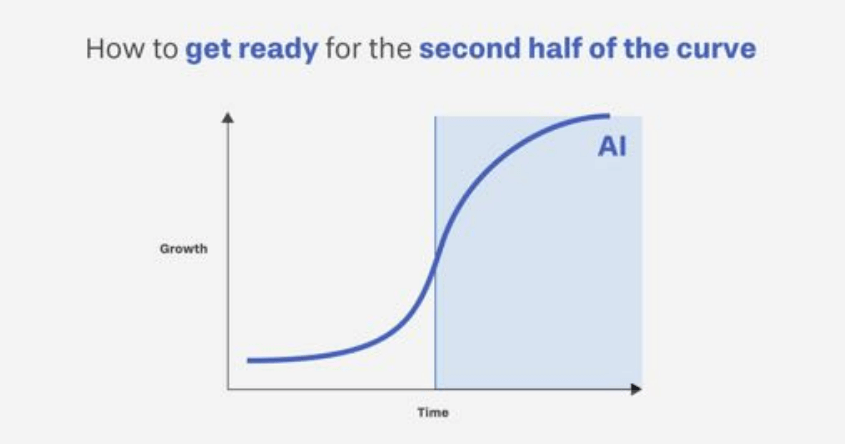
We are still at the beginning of this phase, but there is enough evidence to know that this is the beginning of a new S-curve. When this phase matures, customer relationships will have changed. We just don't yet know what this will look like in five or 10 years. The challenge of business is to think about what the second half of this curve looks like.
To win as a company in the ‘old world,’ you used to have to excel in one thing. For example, the best service or the cheapest. This no longer works, because because of customer expectations, companies have to be good at everything.
We are moving from a mobile first approach to an AI first approach in the near future. Steven's concern here is that companies are getting blinded by technology. The question should be: “What do we need to do for our customers?” Only after that comes technology. Parcel delivery, for example, is still not customer-centric. Meituan Dianping, a company among the top most innovative companies, makes sure your order is delivered within 29 minutes of ordering. They put customer needs first, and come up with an (innovative) solution.
To respond to what is coming, we need to get out of our daily bubble. Ten years from now, we will look back on this time as the prehistory of e-commerce. By understanding today what is coming and by understanding what the customer will want in five to 10 years, we can anticipate it now.
The paradox of the third stage is that it becomes more and more complicated for companies to make it easier and easier for consumers. In this, consumer time is a scarce resource, so as a business you want to save consumer time and improve time they spend.
Three directions will emerge around AI, according to Steven:
In conclusion, we are at the beginning of a new curve. We don't yet know what it will look like, but today is the right time to act on it. Think about customer expectations and desires five to 10 years from now and see what you can do today to become a forerunner in the future. All we need for this is the consumers. Use them as your guide.
CRO is entering an exciting time. Today we need to adopt a focused process, like Facebook, to achieve growth. In addition, CRO will need to grow toward a Center of Excellence to enable others to experiment and validate at a high level themselves. And in the near future, AI is going to play an increasing role. By anticipating the customer needs of the future today, you will ensure that you become a forerunner in this third digital phase. That way, you will continue to achieve growth for your company and customers in the future.

 Nederlands Nederlands
 English