
March 5, 2026
Why experimentation is becoming an operating model for smart organizations
A conversation with Valentin Radu, founder of Omniconvert, on experimentation as an operating model, AI and sustainable digital growth. Read more

We are looking for new colleagues! Check out our vacancies.
Delivery time is an important issue when it comes to e-commerce. Everything we order online has to be delivered to your home somehow from wherever it comes from. After you hit the order button, all sorts of things are set in motion behind the scenes to make that happen. But that takes time.
Many web shops promise us delivery within 24 hours. But there are also plenty that can't deliver that. We too, at Online Dialogue, work for these companies. But how do you handle delivery time communication if you can't deliver 24 hours?
In the following four examples, I demonstrate what we have learned about delivery time.

Here we showed a delivery time indication on the list page. But the dropout on this page was very high. We wanted to know what the delivery time indication could have to do with this, so we removed it in a A/B testing.
At first, this seemed like a great success; the CTR from the list page to the product page and even to the shopping cart went up tremendously. But in the shopping basket, the delivery time became visible. The exit on the shopping cart went up as a result, with a negative result on conversion in the end. Not a success! It seems you had better do a good job of expectation management, so there are no unexpected surprises.

This is example of delivery time during the corona crisis. Normally, you can promise a 24-hour delivery but due to the corona measures, you cannot fulfill this expectation. Indeed, you actually have no idea when your customer can expect the package. So what do you do?
Here we placed a notification where we let you know that it is possible for delivery times to vary. Prior to the A/B test, we were afraid of a negative effect on conversion. But what turned out; this notification had no effect on conversion. It did on behavior. We saw a lot of clicks to the page where we explained why we could not provide clarity about the delivery time. Apparently the different delivery time attracted a lot of attention. And by giving more explanation, we were able to inform visitors about the situation.
We were very pleased to discover that visitors did not mind the unclear delivery time in this case.
So now that we've seen two examples, you would say that you shouldn't surprise your website visitors with relatively longer delivery times at a later date. Read on to see what else we tested.

In this case, some products (phones) were out of stock and we could not give a delivery time indication.
Here we wanted to test what would happen if we redirected visitors to an alternative phone. Unfortunately, we saw conversion drop off quickly. This was actually mainly because in the A variant, phones were still being sold as usual, despite being out of stock. In the B variant, we probably tried too hard to offer something else while visitors had made their choice of product.
Apparently, in the case of phones, a visitor just really wants a particular phone. Therefore, the visitor will be quite willing to wait a little longer for it.
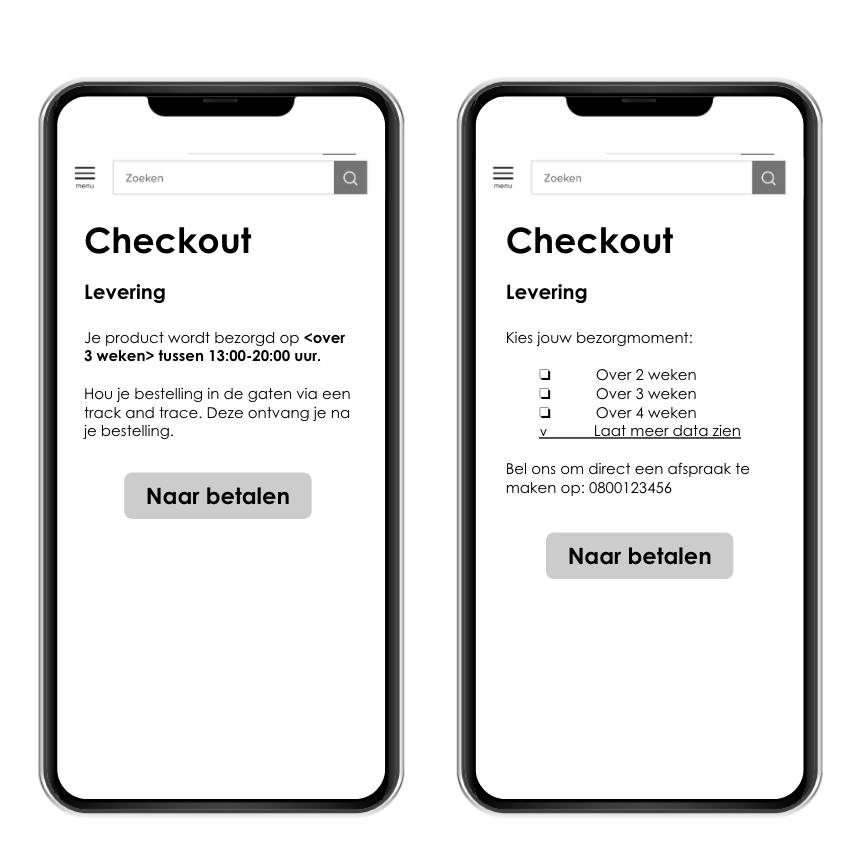
Here we wanted to give the visitors autonomy. When you can make your own choice you stand behind the outcome more than when the decision is imposed. For your information, the experiment contained real data, not in 2 weeks.
In this test, we saw that most visitors wanted to be as informed as possible about the available data. That is to say, many visitors found the link ‘show more data’ used. This caused a date to be chosen more often compared to the visitors who did not view more dates. The visitors who called to make an appointment had the highest conversion rate.
Probably these outcomes had to do with the products delivered by this store: all large products for which you want to be home at the delivery time. Giving multiple options makes people search for the most ideal time.
In the end, we saw that the A variant performed better than the B variant. We can explain this because in A there is no choice at all which actually makes it easier to proceed. The delivery date is imposed on the visitor. In B there is quite a lot of choice, this suddenly makes this an important step. By giving visitors the choice they also want the ideal time to be available. If it is not, they will not complete the order.
We have learned that delivery time has a major influence on consumer behavior. In addition, context also plays an important role. Which products are involved (large, luxury, scarce)? Do you have to be home to receive a product? Or can it be delivered to the neighbors? And is the situation different (corona)?
What we learned about delivery time from our A/B testing:
Experimenting with delivery time is quite tricky. Ideally, you would say; ordered today, delivered tomorrow. Of course you can experiment with these kinds of statements. If you can show that your conversion rate increases significantly you could make a case to show that the delivery time really should be shorter.
Experimenting with communication around delivery time is also a lot of fun. As you can see, we have already learned a lot, but have not yet discovered the egg of Columbus. I'm also afraid we're not going to find it. Context is incredibly important and different for every webshop. Try to find out what is the context in which a visitor visits your site and places or does not place an order. And start experimenting to find out what works for you. Good luck!
 Nederlands
 English