
March 5, 2026
Why experimentation is becoming an operating model for smart organizations
A conversation with Valentin Radu, founder of Omniconvert, on experimentation as an operating model, AI and sustainable digital growth. Read more
Sign up | Online Session: Product Experimentation | September 17
A good CRO process starts with thorough preliminary research in which the customer journey (or customer journey) plays the main role. In most Web analytics tools, it is difficult to see the actual paths customers take. In the average navigation reports, you can see the first two or three consecutive pages. But if you want to look beyond that, it quickly becomes difficult. In addition, it is possible to create funnels, but then you only see the steps you have defined yourself. Therefore, you might miss steps that customers take in between, or overlook paths. So how do you find out which paths your customers actually take? With process mining!
Process mining is analyzing processes based on historical data, for example, the process of your visitors going through your website. By loading analytics data into a tool like Disco, it is possible to visualize the actual paths that visitors take. This allows you to see the most followed paths, but also the paths that take fewer visitors, but are just as important for your sales. Unlike funnels, this way it is also easy to identify blind spots, inefficiencies and dead-end paths. This gives you insight into the entire web of customer paths, and not just the funnel you thought of beforehand.
There are countless routes customers can take on your Web site. When you look at this whole data queue, you quickly get lost in details. So think carefully beforehand about the questions you want to answer, and make them specific. So not “What is my customers” online behavior?“ but ”How do customers navigate on desktop when they've done an add-to-cart?“ or ”Does seeing unavailable products lead to abandonment?" Based on these questions, you then determine what data you need.

For process mining, you need raw data from your analytics tool, for example GA4 data via BigQuery. Your specific research question guides exactly what data you will use. That is at least the pages users visit and the corresponding user id and timestamp. In addition, you may need to supplement the list with key events, such as purchase and add_to_cart. Depending on the research question, you can further expand the data to include, for example, the device type or user login status. Then, using Python, for example, ensure that the dataset is cleaned up. For example, remove query parameters from URLs and group everything in a way that makes answering your research question as easy as possible. For example, it may be useful to group all pages by page type. In fact, it is often more interesting to know where in the journey visitors visit PDPs, than to know which specific PDPs they visit then.
In Disco, you can zoom in on the different paths taken by customers in detail. You can filter, zoom in and view individual visitors. The thickness of the arrow indicates how often a path was used, and the darker the color of a step, the more people visited that step.
This is an example of part of a journey:
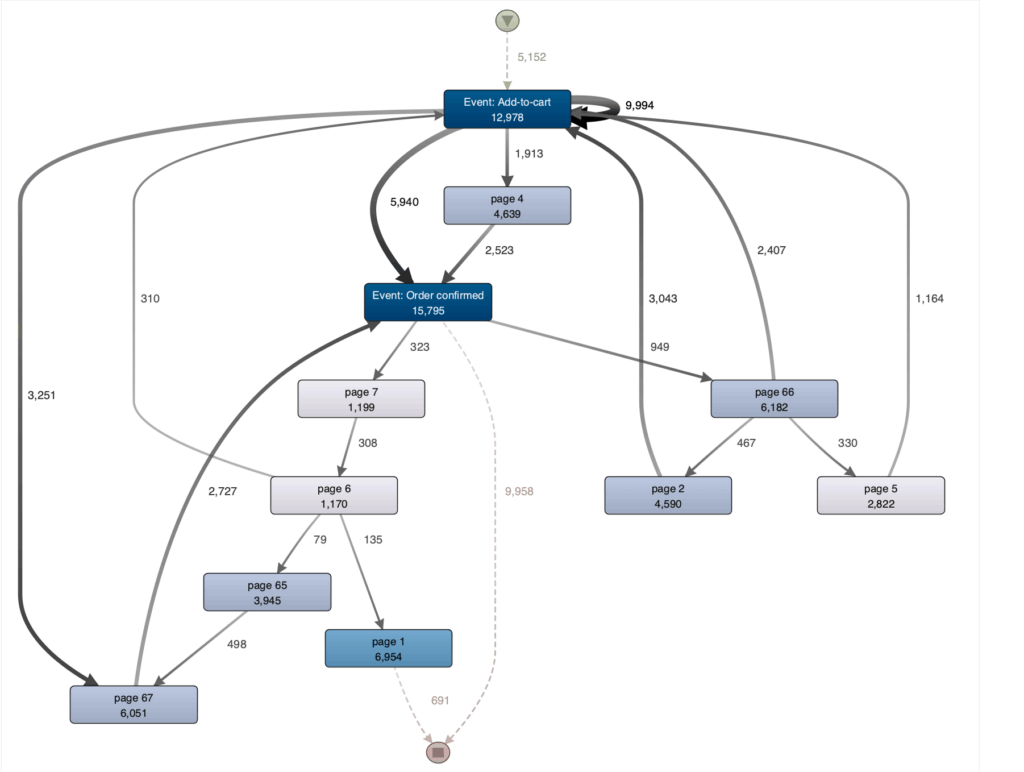
Because you have thought carefully about the data you need beforehand, you can now answer all your research questions based on this one dataset with the right filters and settings. Furthermore, it's always a good idea to also look globally for salient features: are there places where users click in circles?, is there an unexpected place where many users leave the site?, etc.
Now that you have the answers to your research questions, and perhaps discoveries about inefficiencies and blind spots, you can get to work optimizing. You now know how visitors move around your site, and where improvements can be made. And you have a broader picture of user behavior than you ever could have achieved with funnels. Use these insights to come up with hypotheses for A/B testing, follow-up questions for qualitative research, or input for product discovery.
As described above, process mining offers a gold mine of insights into the customer journey. Getting these insights, however, requires some technical knowledge of the SQL database language, the Python programming language, and the Disco software. Are you excited about the opportunities that process mining can provide for your organization, but could use some help? Then contact us. Then together we'll look at how to gain deeper insight into how visitors actually move around your website.
 Nederlands
 English