March 5, 2026
Why experimentation is becoming an operating model for smart organizations
A conversation with Valentin Radu, founder of Omniconvert, on experimentation as an operating model, AI and sustainable digital growth. Read more
We are looking for a data analyst! Check the job posting.

The Dialogue Thursday (DiDo) is by now a well-known phenomenon in CRO-land. About three times a year we organize an afternoon where we invite peers to discuss a specific topic. We work by invitation and there are some conditions you have to meet as a visitor to get in, but once you've been there, you'll want to come back every time. Guaranteed. This time the theme was Product Discovery Sprints. With big names like Fonq, Vattenfall and Maxeda on stage, it couldn't help but be a successful afternoon. I'll take you through the latest edition of the DiDo.

Jeroen van Leenen, head of customer experience at Fonq, kicked off the afternoon. In his talk ‘from strategy to execution: short, mid and long term planning’ he explained how you can hit the sweet spot between your business goals and the customer problems with ‘customer centered business opportunities’. And why it is actually much better to fail sooner than later. Product discovery is about exploring new services and solutions that could deliver to your customers. And how to find and validate them before you implement.

Jeroen van Leenen, head of customer experience at Fonq
The playing field of product discovery aims to exploit or explore. With exploit, the focus is on optimizing and scalability of existing products or services. When you explore, you work on discovering new products and services. According to Jeroen van Leenen, there are three main components that fit into the playing field of product discovery.
1 Problem discovery: what is the consumer's problem?
2 Solution discovery: what are the conditions/needs for my solutions?
3 Technical discovery: can I make it / can I implement it?
With his team at FONQ, he works with a theme-based roadmap: Now/Next/Later. This roadmap works on the basis of an OKR cycle. The Objective Key Results provide clarity on execution and orientation for discovery. But you don't know what you will deliver, how long it will take, or exactly what you will do. This totally different way of looking at projects provides a much richer basis for experimentation. Because let's face it, the fixed scope projects always end in changing the scope, moving the deadline or burnout anyway.
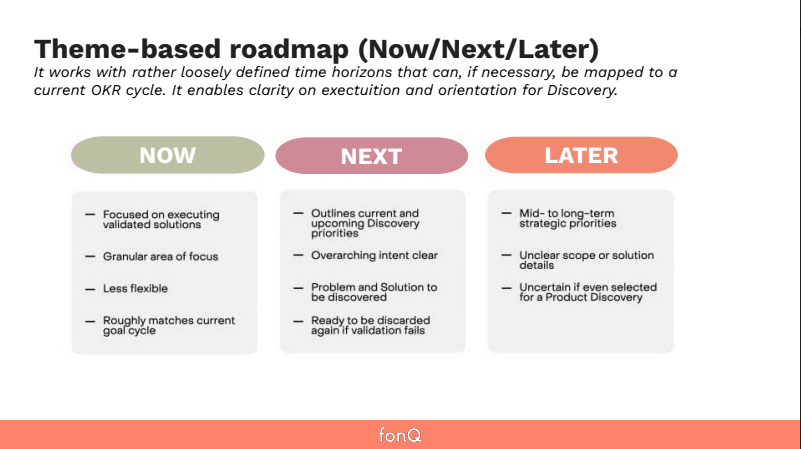
Theme Based Roadmap (from presentation FONQ)
An elevator that is too slow
Peter Drucker once said, ‘there is nothing more dangerous than the right answer to the wrong question. A good example of this is the problem of ’an elevator that's too slow. You might say, we're going to convert the elevator so it's faster. Problem solved right? Yes, but rebuilding the elevator is very expensive financially. By looking at the underlying problem of ‘too slow elevator,’ you come up with ‘people don't like the long wait. By following the product discovery process, there are plenty of other solutions you can think of that cost a lot less money. Like hanging mirrors on the inside of the elevator. That way people can take a moment to decorate themselves before they arrive at their destination.
HiPPO, PUMA, ZEbRA, RHiNO. Alex Wesselink, User Experience Designer at Vattenfall, managed to put the process together beautifully. As befits a good UX'er, his presentation was visually sublime, and he talked enthusiastically about data-driven testing of propositions without existing data. Something you will often run into in the discovery process. He argued that precisely as costs go up, the ability to change things goes down. And right in between, is where optimization takes place.
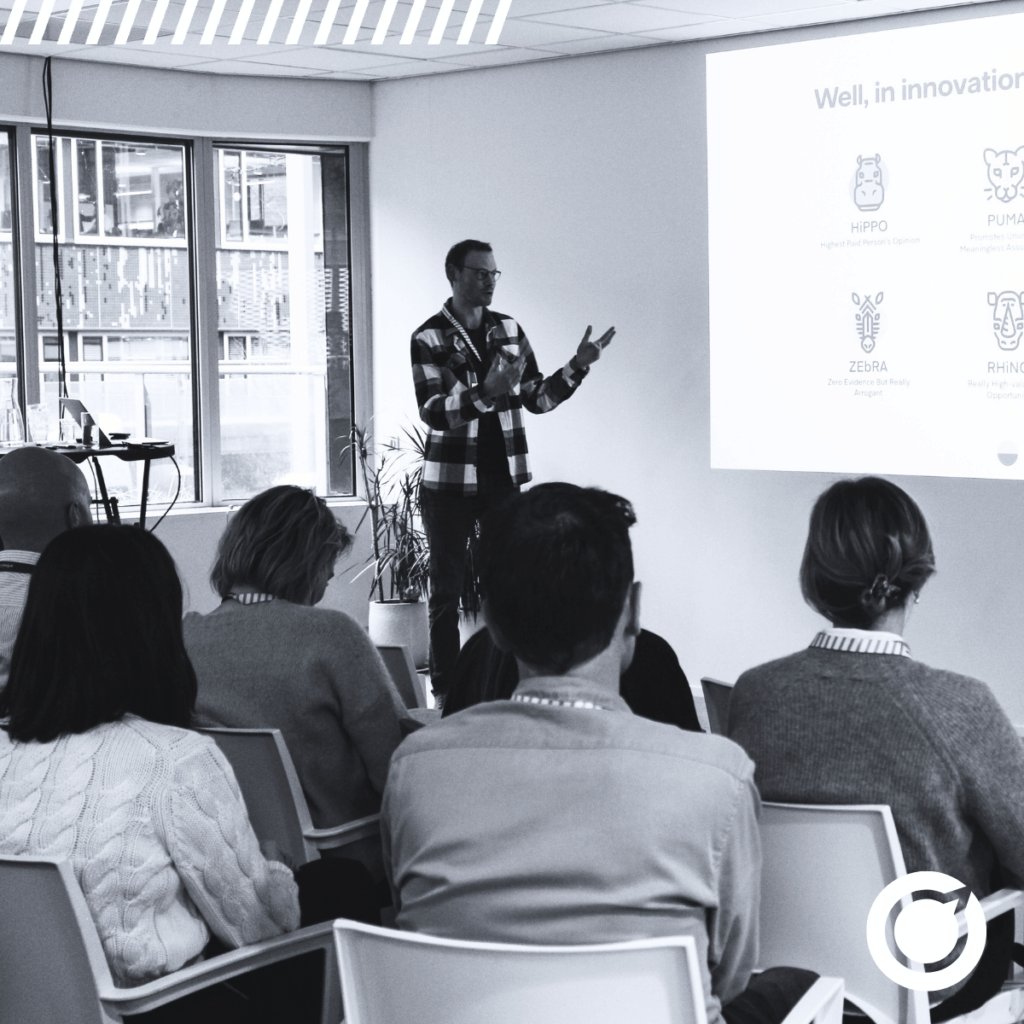
Alex Wesselink, User Experience Designer at Vattenfall
In his ‘safari’ (product development) down the elephant paths (shortcuts in exploration), he talked about the different animals we encounter in the discovery process. He stated: more opportunities = more stakeholders = more opinions = more money = more problems. And in the animal kingdom, what we know we can trust. So success is defined by the limit of their own thinking. Because animals are lazy, they often take the elephant paths, the quickest route to known success. And that short route is a waste, because you miss out on a lot.

From presentation Vattenfall
To survive on Savannah, we must let go of the status quo. We do this by involving stakeholders in defining success, making the most of the find-phase and employing growth hacking methods. His key take-aways to product discovery survival:
Finally, Sacha Serra, conversion optimization analyst at Maxeda and OD's conversion manager Shirley van Haalem spoke. Maxeda is one of the largest DIY retailers in the Netherlands and Belgium and has also launched a marketplace since February 2023. They use the triple diamond in the discovery process: problem, solution, development in collaboration with Online Dialogue.

Sacha Serra, conversion optimization analyst at Maxeda and OD's conversion manager Shirley van Haalem
... Just a quick note: we send out a newsletter every three weeks that includes the latest blogs, team updates and, of course, news about the offerings in our academy. Click here to subscribe.
They told the story of Maxeda and how they use the triple diamond model as a framework for process improvement. The triple diamond framework consists of three phases that repeat each other. The discovery phase consists of two diamonds: problem discovery & problem definition and solution discovery & concept validation. The last diamond contains the development phase (design & development) validation (early access program) and rollout (commercial availability).
Maxeda's mission is to build a solid product management process by validating ideas and concepts at an early stage. This leads to the deployment of resources in valuable places and helps suggest the right products and features for customers. Shirley recently wrote an article on product discovery for agile processes.
Next DiDo's are on June 1 (Marketplaces) and Sept. 28. More on the content and registration link will follow later, but keep an eye on the DiDo page.
And especially for conversion managers, we're holding a meetup on May 11 where we'll have a deep-dive discussion about discovery sprints. You can sign up here: https://forms.gle/hfWv9x61Ro73x48n9
 Nederlands Nederlands
 English