March 5, 2026
Why experimentation is becoming an operating model for smart organizations
A conversation with Valentin Radu, founder of Omniconvert, on experimentation as an operating model, AI and sustainable digital growth. Read more

We are looking for new colleagues! Check out our vacancies.
On May 14, Online Dialogue hosted its first online CRO Unconference. Prior to the unconference part, I gave a presentation on motivating people and organizations to adopt CRO. Below is a summary of this presentation.
As conversion specialists and data analysts, we want to change the culture, mindset and way of working within organizations. We strive for an experiment and data-driven culture. However, behavior change is hard. Very difficult.
Dr. Edward Miller has an investigation performed on patients with clogged blood vessels. This is a serious condition because it is terribly painful and leads to early death. If these patients want to prevent the pain from coming back and if they want to stop the progression of heart disease before they die from it, they must ‘simply’ change their lifestyle. They must stop smoking, drinking and overeating. And also start exercising and reducing stress in their lives. Unfortunately, very few people succeed in this. Ninety percent cannot change their lifestyle, with serious consequences!
That should get us thinking. If change is so difficult, even in a life-and-death situation, how are we going to change entire organizations?
Within our work, too little attention is paid to organizational change. How can we get our colleagues on board, and convince them of the importance of our great work?
Fortunately, we already know quite a lot about behavior change. We are working on this every day on many websites. We try to change the behavior of website visitors. We can also use this knowledge to change the behavior of our colleagues. For this, I use the following model:
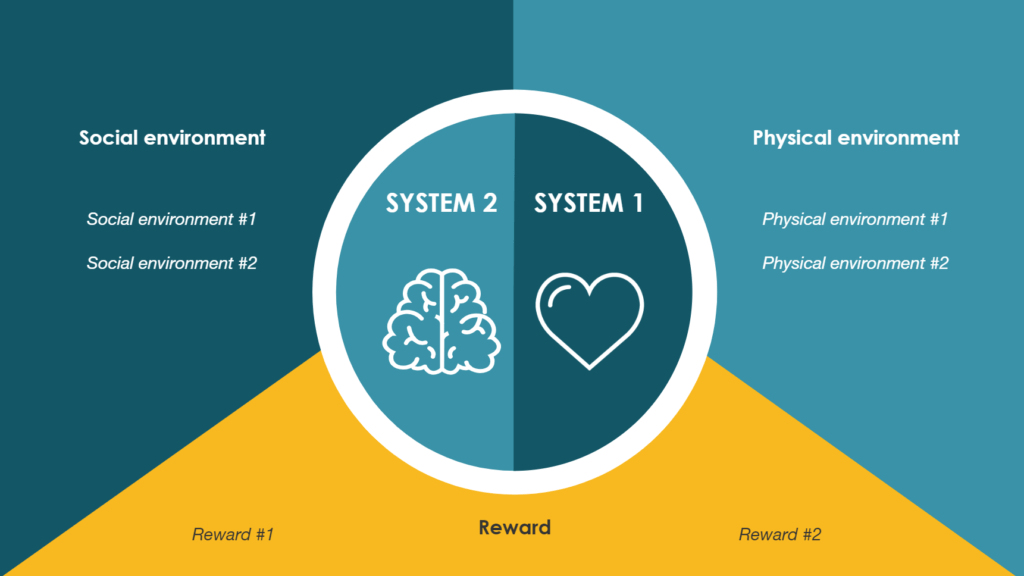
System 2 is (a metaphor for) our conscious rational brain. This part of the brain can reason and think in the past, present and future.
Example: System 2 takes place when you set your alarm on Saturday night to go running on Sunday morning before your partner wakes up. This is a conscious process. System 2 knows that you can have breakfast with your partner after running, and if you keep it up, you will have a well-trained body in the summer.
System 1 Is our unconscious brain. This is the strongest part of our brain. It is our reflexes and instincts and it can, after many repetitions, learn. A rule of thumb is that 95% of our decisions are made by System 1.
For behavior change to succeed, system 1 and system 2 must be aligned. And since system 1 is the strongest part of the brain, we want system 1 to work for us.
Example: when your alarm clock goes off on Sunday morning, system 2 knows you have to get out of bed. System 1, however, cannot think in the past, present and future. That well-trained body in the summer doesn't matter to System 1. All it cares about is the here and now. And now is lying under a warm blanket, on a soft mattress with your head on a comfortable pillow. All System 1 wants to do is turn off the alarm clock and get some more sleep. So the battle begins...
As conversion specialists, we constantly modify the physical environment of our Web site visitors to change their behavior. But you can also adapt your own physical environment for successful behavior change.
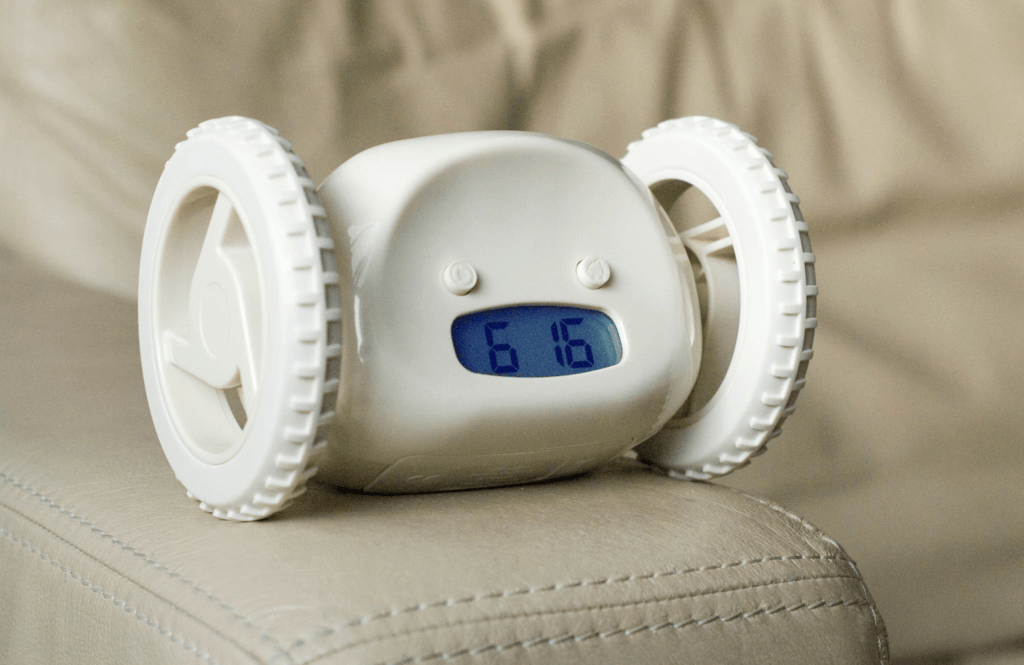
Example: students at a university in the US have invented an alarm clock called Clocky. Like any alarm clock, Clocky makes a lot of noise when it goes off. Clocky, however, is an alarm clock on wheels. It keeps driving around your room until you turn it off. Now, on this Sunday morning, System 2 wants to get out of bed to run. System 1 wants to get out of bed to stop that awful sound. By the time you grab the alarm clock, you are out of bed and awake, ready to run.
From our A/B testing, blogs and presentations, we, at Online Dialogue, know all too well the power of social proof. Consider ratings, reviews, testimonials, etc.. Social proof can also be used for behavior change.
Example: if you meet up with a good friend at the park at 8 a.m. on Sunday morning, System 1 does not want to disappoint your friend. Therefore, System 1 is motivated to get out of bed when the alarm goes off.
Rewards make the new behavior stick. You can combine a reward with something visitors have to do. Rewards come from within, your physical environment and your social environment.
Example: while running, you get a surge of endorphins, which make you feel good. You can also feel good by putting a check mark on your goal list after running. Or while you're in the shower, your partner can make your favorite healthy breakfast as a reward.
Rules and standards can make certain behaviors ‘mandatory. Think coming to work on time, cleaning up your desk at the end of the day or doing one A/B test per sprint.
Example: Our government will not force us to run on Sunday mornings. But why did you run during gym class at school? It was your teacher who told you, and you complied.
Of course, there is more to organizational change than this. You need a compelling vision, change strategy, change team, successes and more. However, the model and knowledge we already have can help make change happen. It will help motivate more colleagues to start experimenting and get a data-driven mindset.
Consider how you can use this model in your own organization. How do you motivate colleagues to be data-driven and experiment-driven?
These are five interesting books on the model:
I will be writing and sharing more on this topic in the coming weeks on my LinkedIn page.

 Nederlands Nederlands
 English