July 3, 2024

We are looking for new colleagues! Check out our vacancies.
Forer Effect

This article - written by the team of psychologists at Online Dialogue - was previously published at Webanalists.com.
“We readily recognize ourselves in vague, predominantly positive and generalized personality descriptions.”
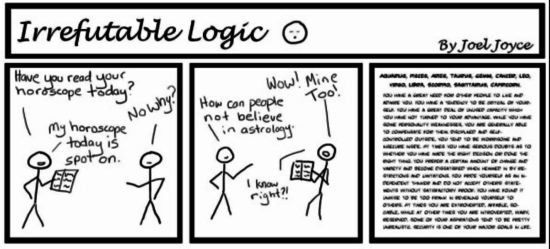
The Forer Effect (also called Barnum effect) describes our tendency to attribute the accuracy of personality descriptions to our own character, as if they were written specifically for us. In reality, however, these descriptions are vague, mostly positive and very generalizable to a large group of people.
The whereas positive and vague core of the message allows us to project our own opinions and findings into the message. In this way, the message becomes ‘personal’ to us. Take, for example, the texts of horoscopes that you can read in some magazines. The vagueness of the text allows us to give our own meaning to it. Thus, that description automatically becomes personal.
Scientific Research example
You have just started at the University and you are getting your first introductory course in psychology. In this subject, your professor (not entirely coincidentally named: Bertram Forer) asks you to fill out a personality test. After you fill it out, a week later the result is reported. In the personality description you receive you read, among other things, that you “have a high need for appreciation and recognition from others,” “you tend to think critically of yourself,” and “you are ambitious.”.
How would you rate the accuracy of this personality description? Bertram Forer found that (on average) his students rated the accuracy of the personality description with a 4.2 on a 5-point scale. Pretty good for a description that was the same for everyone!
Online Persuasion tips
To personally connect your customers to your brand, or if you want to otherwise ‘create a sense of recognition within your potential customer,’ you can use the following points to influence that:
- Refer to relatively vague and generalized personality traits (such as “Are you someone who likes to share knowledge?”).
- Highlight mostly positive attributes of your brand or product.
- Emphasize that your solution is perfect for “these kinds of people.”.
Continue reading about the Forer effect
You may also find these blogs interesting
We've detected you might be speaking a different language. Do you want to change to:
 Nederlands Nederlands
 English