
March 5, 2026
Why experimentation is becoming an operating model for smart organizations
A conversation with Valentin Radu, founder of Omniconvert, on experimentation as an operating model, AI and sustainable digital growth. Read more

We are looking for new colleagues! Check out our vacancies.
Human behavior is very complex and therefore difficult to predict. Yet all kinds of behavioral scientists have been doing research for years to get a handle on our behavior. Each has created his or her own model. These models tell us how behavior broadly works. Super useful when trying to explain and change behavior.
At Online Dialogue, we are finding out more and more that we can explain online behavior of visitors on a Web site much more specifically. General models can help us find the right direction, but do not suffice in the details. Through our research, we are able to explain more and more precisely how behavior comes about.
In this article, I explain how existing behavioral models can help you give direction to your own behavioral model. And in particular, how to validate your prediction through A/B testing.
I will review the existing ‘Behavior Model For Persuasive Design’ of B. J. Fogg as an example. This is one of our widely used models. This model tells us that behavior depends on the balance between (1) motivation and (2) to what extent a person is able to exhibit the desired behavior (ability). In addition, you can use (3) triggers to bring about behavior.
For this behavioral model, I use a fictional web shop that sells coffee machines as an example.
We always start with a data study that maps out current behavior. Here we look at web data, user tests, surveys, customer journeys, etc. We try to gather as detailed information about the customers as possible.
From data and psychology, you make a first draft of the behavioral model, which is a prediction. In it you put all the factors you expect to influence conversions.
For the fictional coffee machine web shop, we will assume for a moment that the data gives reason that motivation predicts buying a coffee machine. A model such as B. J. Fogg's helps give us direction for experiments. B. J. Fogg describes that motivation can arise from several factors. In this case, pleasure, pain, hope, fear, social acceptance and rejection. The challenge is to discover specifically for your Web site what influences motivation. You can then incorporate the listed factors for motivation (pleasure, pain, hope, fear, social acceptance and social rejection) into A/B testing.
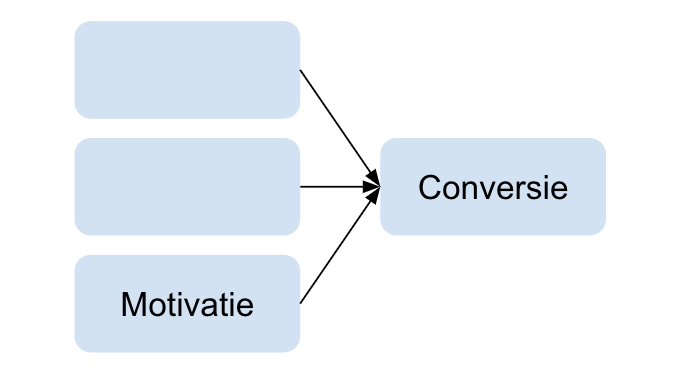
A/B testing allows us to discover what factors work and don't work for our website specifically.
Suppose we find out that pleasure has a positive effect on coffee machine sales, but the other factors do not. Then we can incorporate into our model that motivation is positively influenced by pleasure.

Anyway, then we're not there yet. Fun is a pretty general term. If we tell our clients to add more fun on their website, they probably don't get it. And neither do we, for that matter.
Therefore, we would like to explore this term further. Pleasure, in the case of the fictional webshop, for example, can be divided into a) user experience, a pleasant experience on the website, b) the expected pleasure when purchasing the coffee machine, c) brand experience, everything around pleasant communication and trust in the brand. And so on and so forth. By running A/B tests based on these specific components of enjoyment, we will find out which component of enjoyment most affects coffee machine sales.
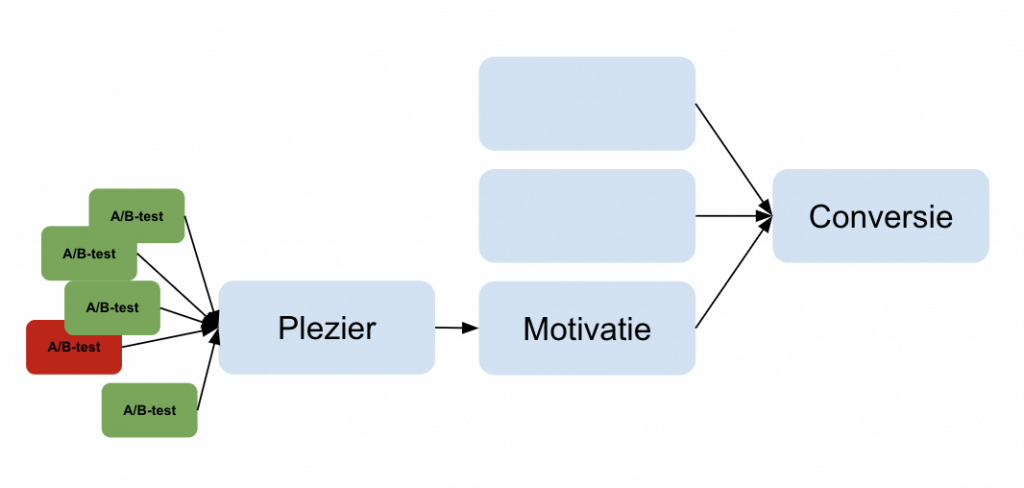
So it is important to research what causes pleasure specifically for your website.

This example shows how our process of validation works for one predictor, in this case motivation. Of course, there are always multiple predictors that you want to get a handle on in your behavioral model. Eventually you work toward a model with multiple predictors that you know how they influence buying behavior.

This is a process of a lot of A/B testing where you try to find winning experiments that contribute to your model. But you're bound to have losing experiments, too. These will tell you what factors are not having the desired effect. And you learn from those, too! It's a matter of trial and error, trying and restructuring. Everything contributes to building the most specific behavioral model possible for your website.
Success! And could you use help with this? Please visit contact with me!
 Nederlands
 English